
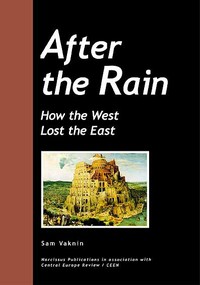
After the Rain : how the West lost the East by Samuel Vaknin
Samuel Vaknin's After the Rain: How the West Lost the East is not your standard history of post-communist Europe. Forget a simple tale of good guys and bad guys. Vaknin paints a complex, and frankly, pretty grim picture of the 1990s.
The Story
The book's core idea is that the West, particularly through institutions like the IMF and the World Bank, pushed a rigid set of economic policies on Eastern Europe—privatization, austerity, rapid deregulation—without understanding the local realities. Vaknin calls this 'market fundamentalism.' He argues this wasn't a genuine transition to a healthy economy, but a chaotic fire sale. State assets were snapped up at bargain prices by well-connected insiders, former communist officials, and foreign investors, creating the oligarchic class that dominates many of these countries today. The result, he says, was not prosperity but de-industrialization, massive poverty, and a deep public distrust in democracy itself. The 'rain' of freedom, in his view, was followed by a flood that washed away stability and created the conditions for the populist and authoritarian politics we see now.
Why You Should Read It
I'll be honest, this book made me angry and it made me think. Vaknin writes with a fierce, almost prosecutorial style. He's not a detached observer; he's someone who lived through this period and is calling out what he sees as a colossal failure. Whether you fully agree with him or not, his perspective is crucial. It forces you to question the triumphant narrative of the West 'winning' the Cold War. He connects economic policy directly to social decay and political backlash in a way that feels incredibly relevant today. It helps explain the simmering resentment in parts of Eastern Europe toward both their own leaders and the EU. This book gives you a framework to understand headlines from Poland, Hungary, or Bulgaria that might otherwise seem confusing.
Final Verdict
This is a challenging but essential book for anyone trying to make sense of modern Europe and the global economic order. It's perfect for readers of history and politics who are tired of simple explanations and want a more critical, ground-level view of recent history. It pairs well with books like Naomi Klein's 'The Shock Doctrine' for understanding economic upheaval. Be warned: it's dense, opinionated, and bleak. But if you're willing to sit with its arguments, 'After the Rain' will fundamentally change how you see the world that emerged from the ashes of the Soviet empire.
James Clark
6 months agoThis book was worth my time since the atmosphere created is totally immersive. A valuable addition to my collection.
David Hernandez
1 year agoBased on the summary, I decided to read it and the content flows smoothly from one chapter to the next. One of the best books I've read this year.
Deborah Wright
9 months agoIf you enjoy this genre, the flow of the text seems very fluid. One of the best books I've read this year.






David Williams
1 year agoI came across this while browsing and the flow of the text seems very fluid. Don't hesitate to start reading.