
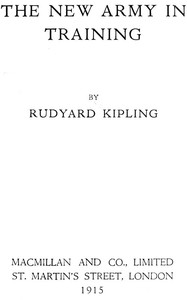
The New Army in Training by Rudyard Kipling
Rudyard Kipling, famous for tales of empire and adventure, turns his reporter's notebook on a monumental task: the creation of Britain's 'New Army' in 1915. With the regular army decimated in the early battles of WWI, the UK had to build a massive fighting force from volunteers who had never held a rifle. This book is Kipling's eyewitness account from the training camps.
The Story
There isn't a traditional plot. Instead, Kipling takes us on a tour. We visit different regiments and camps, watching the process unfold. We see men from all walks of life—bankers next to ploughmen—being issued ill-fitting uniforms, struggling to form straight lines on the parade ground, and learning the basics of warfare. He describes the relentless drilling, the mock battles in the English countryside, and the vital, unglamorous work of cooks, signalers, and medical orderlies. The 'story' is the transformation itself: the confusion, the camaraderie, the sheer hard work, and the emerging sense of a shared, grim purpose.
Why You Should Read It
Forget dry statistics. This is history with mud on its boots and a wry smile. Kipling's genius is in the details: the description of a thousand boots hitting the ground at once, the soldiers joking about their terrible cooking, the earnest concentration on a recruit's face as he learns to assemble his kit. His respect for these ordinary men is palpable. He doesn't glorify war; he shows the exhausting, practical work that precedes it. You get a real sense of the scale and the human cost of this national effort, not in blood yet, but in sweat and sheer will. It's a powerful reminder that an army is made of individuals before it becomes a unit.
Final Verdict
Perfect for history buffs who want a ground-level view of WWI, or for anyone interested in superb narrative journalism. It's also a fascinating side of Kipling, less as a storyteller and more as a keen social observer. If you enjoy first-hand accounts that capture a specific moment in time with humor and humanity, this short book is a hidden gem. It's not a war story; it's the story of everything that had to happen before the war could even be fought.
Carol Scott
11 months agoGood quality content.
Oliver Miller
1 year agoA bit long but worth it.
Brian White
1 year agoI started reading out of curiosity and the flow of the text seems very fluid. I learned so much from this.