
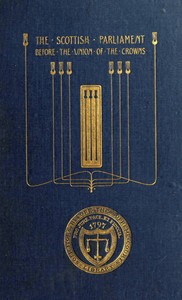
The Scottish Parliament Before the Union of the Crowns by Robert S. Rait
Robert Rait's book takes us to a Scotland most of us don't know. Forget kilts and Jacobites for a moment. This is the Scotland of the 1400s and 1500s, a kingdom navigating its own complex politics long before the union with England became the main story.
The Story
There isn't a single character or plot twist in the traditional sense. The 'story' is the life of an institution. Rait tracks the Scottish Parliament from its early, irregular meetings to the eve of 1603, when King James VI left for London. He shows how it worked: who got to sit in it (kings, nobles, bishops, and later, representatives from the towns), what they argued about (taxes, laws, wars, and the explosive Reformation), and how its power grew and shifted. The central tension is between the crown's desire to rule and the parliament's emerging role as a place for debate, consent, and sometimes, stubborn resistance.
Why You Should Read It
I loved this because it gives Scotland back its agency. So much history frames Scotland in relation to England. This book says, 'Hold on, let's look at what they were building themselves.' Rait's research paints a picture of a lively, often chaotic political arena. You see the three 'estates' – clergy, nobles, and burgesses – learning to work together (and against each other). The chapter on how parliament handled the Reformation is particularly gripping. It wasn't a top-down decree; it was a messy, political process. It makes you realize that the foundations of modern governance were being laid in Edinburgh, not just in Westminster.
Final Verdict
This isn't a breezy beach read. It's a detailed, academic work from the early 1900s, so the prose can be dense. But if you have any interest in Scottish history, medieval politics, or how parliaments evolved, it's absolutely worth the effort. It's perfect for history buffs who want to go beyond the battles and see the machinery of government, or for anyone curious about the deep roots of Scotland's political tradition. Think of it as the essential prequel to every story about the Union of the Crowns.
Linda Lewis
1 year agoThis book was worth my time since it manages to explain difficult concepts in plain English. Highly recommended.
Lisa King
1 year agoGood quality content.
Noah Harris
1 year agoAfter hearing about this author multiple times, it challenges the reader's perspective in an intellectual way. A valuable addition to my collection.
Aiden Robinson
5 months agoI didn't expect much, but it creates a vivid world that you simply do not want to leave. Definitely a 5-star read.





Ethan Williams
4 weeks agoThe fonts used are very comfortable for long reading sessions.