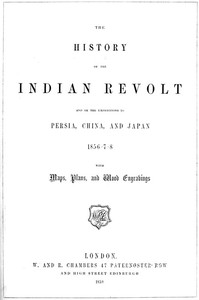
George Dodd's 1859 chronicle opens not with a single battle but with a question: why did the Bengal army's sepoys rise while the Madras and Bombay forces remained quiet? The preface immediately frames the revolt as a puzzle of caste and creed, noting that 'Hindoos of the Brahmin and Rajpoot castes rebelled' while lower castes and Sikhs stayed loyal. This analytical bent—treating the mutiny as a problem to be solved through evidence—shapes the entire work.
The narrative voice is that of a compiler drawing on official dispatches and eyewitness reports. Dodd rarely editorializes; instead he lets quoted testimony carry the drama. A besieged officer's description of enemy gunners hiding in 'very narrow trenches about eight feet in depth' so that 'our baffled sharpshooters could only see their hands while in the act of loading' is typical of the granular, tactical detail that distinguishes this account from more sensational histories.
The Siege as Sensory Record
Dodd's account of the Lucknow Residency siege is remarkable for its attention to physical misery. He catalogs not just casualties but the stench of dead bullocks, the 'painful boils' afflicting officers, and the 'hot vapours from stagnant pools' that bred fever. The narrative dwells on logistics: commissariat breakdowns, half-rations, and the grim task of burying animals at night. This sensory detail—heat, disease, rot—serves as a counterweight to heroic rhetoric. Dodd notes that even wet days brought no relief, as the vapours 'engendered fever, cholera, dysentery, and diarrhœa.' The cumulative effect is a portrait of endurance stripped of romance.
The Puzzle of Loyalty and Revolt
Dodd's preface poses a series of questions about why different groups acted as they did: why Sikhs and Punjaub Mussulmans showed 'so little sympathy with the insurgents,' why Bengal Hindoos were 'timidly quiet' while those of Hindostan were 'boldly violent.' These queries are not answered definitively—the excerpts offer no resolution—but they reveal the author's method: treating the revolt as a case study in imperial governance. The narrative repeatedly returns to distinctions of region and rank, suggesting that Dodd saw the mutiny less as a unified uprising than as a fractured event shaped by local conditions.
The Officer's Voice in the Text
Dodd frequently cedes the page to quoted testimony, particularly from officers under siege. One extended passage describes how the enemy 'had recourse to digging very narrow trenches about eight feet in depth in rear of each gun,' a tactic that frustrated British artillery. The quoted speaker uses precise language—'baffled sharpshooters,' 'extreme proximity'—that contrasts with Dodd's own more measured prose. This layering of voices gives the narrative an documentary quality. The reader hears not just what happened but how participants described it, complete with the technical jargon of siege warfare.
The Domestic Front of the Siege
Amid the military narrative, Dodd inserts a striking passage on the plight of women and children inside the Residency. He asks directly: 'what were the ladies and children doing during this terrible month of July?' The answer is a catalogue of deprivation: no time to gather property, native servants fleeing or robbing their masters, children dying rapidly, and hospital rooms 'always full.' Dodd notes that the church was 'full of grain,' forcing worshippers to meet 'in any available spot.' This attention to domestic disruption—the collapse of ordinary life—underscores the siege's totality, extending the conflict beyond the battlefield into every corner of the compound.
Dodd's history rewards readers who attend to its structure as much as its events. The juxtaposition of tactical reports with domestic detail, the unanswered questions about caste and loyalty, and the reliance on quoted testimony all reflect a Victorian editorial sensibility that valued evidence over interpretation. For those interested in how nineteenth-century Britons processed imperial crisis, this text offers a rich, if partial, record—one that reveals as much about the chronicler's assumptions as about the revolt itself.
Reading Dodd's account of the siege, I kept thinking about how empires unravel in small, human ways—through rumor, suspicion, and faith misplaced. There's a strange kinship with that old Rasputin pamphlet, where loyalty curdles into ruin just as quietly. Rasputin the Rascal Monk Disclosing the Secret Scandal of the Betrayal of Russia by the Mock-Monk Grichka and the Consequent Ruin of the Romanoffs. With official documents — A Closer Reading feels less like history and more like a sigh echoing down decades.