
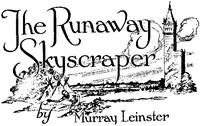
The Runaway Skyscraper by Murray Leinster
Let's talk about a book that proves a great idea doesn't need a thousand pages. Published in 1919, Murray Leinster's The Runaway Skyscraper is a blast from the past that still feels fresh.
The Story
One ordinary afternoon, a 60-story office building in New York City experiences a strange tremor. When the shaking stops, the view out the window isn't of other skyscrapers—it's of untouched wilderness. The entire structure and everyone inside have been thrown back to a time before European settlers arrived. No explanation, no warning. The story follows Arthur Chamberlain, a sensible engineer, as he and the building's manager, Estelle Woodward, try to prevent panic and organize the survivors. They have one building's worth of early 20th-century resources—some tools, a cafeteria, library books, and their own diverse skills—to face an endless forest. The conflict isn't with dinosaurs or cavemen; it's against hunger, fear, and the monumental task of building a future with a committee of stranded office workers.
Why You Should Read It
What grabbed me wasn't the time travel mechanics (which are hand-waved), but the fascinating social experiment. Leinster takes a cross-section of 1919 society—the wealthy, the working class, men, women—and strips away all the rules. Watching them figure out what matters now is the real joy. The engineer becomes vital. The secretary's organizational skills save lives. The story has an optimistic, can-do spirit that feels uniquely of its era, arguing that cooperation and practical knowledge are our real strengths. The characters are types rather than deeply complex, but that works for this fable-like tale. It’s a quick, propulsive read that makes you think: 'What useful skill do I bring to the table?'
Final Verdict
This is a perfect pick for a lazy afternoon. It’s for anyone who loves the 'stranded community' premise of shows like Lost but prefers a shorter, tidier story with a classic feel. History fans will get a kick out of the 1919 attitudes and problem-solving. Science fiction readers can see the blueprint for so many stories that came after. And if you're just curious about the wild ideas they were dreaming up over a century ago, this is a delightful time capsule. Don't expect hard science or deep drama—expect a clever, charming, and fundamentally hopeful adventure about starting over.
Anthony Martin
2 months agoEssential reading for students of this field.
Brian Flores
1 year agoGood quality content.
Christopher Rodriguez
1 year agoI came across this while browsing and the narrative structure is incredibly compelling. A true masterpiece.
Richard Allen
1 month agoAfter hearing about this author multiple times, the storytelling feels authentic and emotionally grounded. Absolutely essential reading.


Matthew Sanchez
1 year agoHaving read this twice, the plot twists are genuinely surprising. This story will stay with me.