About 569 minutes
Tales, Traditions and Romance of Border and Revolutionary Times — Text and Context
Modern Nations
130,829 recorded words. 35 minutes difference from this book's estimate.
View Gutenberg source #51864
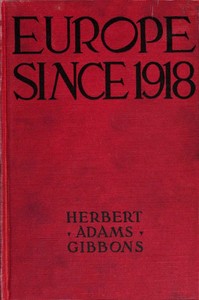
The catalog record for Europe Since 1918 — Edition Insights provides practical reading context through 138,791 words, 10 hr 4 min estimated reading time, and 37 detected text sections.
The text analysis averages about 24.7 words per sentence, while the detected sections provide another way to judge how the source is divided.
Project Gutenberg metadata also associates the work with “Europe -- History -- 1918-1945,” connecting these edition facts with the source record’s subject description.
Explore this collection
These alternatives are selected using recorded categories and estimated reading time.
About 569 minutes
Modern Nations
130,829 recorded words. 35 minutes difference from this book's estimate.
View Gutenberg source #51864About 564 minutes
Modern Nations
129,527 recorded words. 40 minutes difference from this book's estimate.
View Gutenberg source #73564About 546 minutes
Modern Nations
125,394 recorded words. 58 minutes difference from this book's estimate.
View Gutenberg source #61310Search stored excerpts and compare books → Choose by your preferences →
Choices use stored catalog measurements. Estimates vary with reading speed. A shared category is a catalog label, not a claim that two books have the same argument or literary quality.
Search reads excerpt text stored with this catalog and links to its associated Gutenberg record. The connection is stored in the site database; this tool does not recheck that every excerpt is word-for-word identical to that external record. Excerpt search does not cover every chapter and does not verify historical publication dates.
Catalog snapshot checked: 2026-09-25. Coverage: 94 public books, 94 available source excerpts.
Calculated from edition completeness, EPUB availability, text structure and catalogue metadata. Not a user rating.
Total of 100 points, scaled to a 2.5-5.0 range. Editions with an empty description or a missing EPUB file are not scored.
Public-domain source text
The source text is kept in the dedicated reader, separate from this catalogue record and its commentary.
Herbert Adams Gibbons opens Europe Since 1918 with a striking metaphor: the pre-war world as Humpty Dumpty, precariously perched for a century before its fall. The author warns that the postwar cry for a 'new world order' and 'a war to end war' ignored the nursery rhyme's lesson—that once shattered, Humpty Dumpty cannot be reassembled according to anyone's plan. This framing sets the tone for a skeptical, ground-level examination of the peace settlements and their unintended consequences.
Gibbons, a journalist and historian who wrote extensively on international politics, brings a reporter's eye to the volatile borderlands of interwar Europe. The excerpts reveal a particular focus on the interplay between nationalist movements and class interests, especially in Hungary and its lost territories.
Gibbons uses the Humpty Dumpty nursery rhyme as a structural device for the entire work. The foreword presents the pre-1914 world as a fragile equilibrium maintained by fear of consequences. When the fall came, 'the first dismay gave way to rejoicing' as victors imagined they could remake the world according to their own design. Gibbons explicitly states that some participants 'had no intention of actually letting Humpty Dumpty fall to pieces,' while others believed they could reconstruct him 'in a way that would suit us.' This metaphor recurs implicitly throughout the excerpts, as the author examines how the postwar order failed to account for deep-seated economic and social forces.
The author's dedication to Henry Morgenthau further signals his critical stance: Morgenthau 'does not share my lack of faith in the Versailles Covenant' and offers 'less harsh and sweeping' judgments. Gibbons positions himself as a disillusioned observer, skeptical of the peacemakers' ability to impose lasting stability.
A central tension in the excerpts is the conflict between nationalist irredentism and class interest, particularly in the region 'from the Baltic to the Black Sea.' Gibbons details how Hungarian irredentist organizations—the 'Argrad Blood Association,' the 'Turanian Association,' and the 'Hungarian Defense League'—spread into Slovakia, Bukowina, Transylvania, and the Banat of Temesvár. Yet he notes that the agrarian question prevents these movements from becoming 'already serious—alarmingly serious.'
Hungarian peasants in 'unredeemed' lands, though Magyars, hesitate to return to Hungarian rule because peasant proprietorship has advanced in Rumania, Jugoslavia, and Slovakia, while Hungary remains 'under the domination of the land-owning classes.' Gibbons presents a nuanced picture: oppression of Hungarians in the successor states 'has been confined to landowners and townspeople,' and peasants have actually profited. The author identifies a recurring dilemma: 'national pride or class interest'—a question that applies across the region.
Gibbons extends his analysis to Poland, which faces an 'embarrassing dilemma.' Poland wants to expel Germanic influence from the Baltic states, but that influence is 'based upon the landed aristocracy,' which is also 'the foundation of Polish influence in the Russian border-lands and Eastern Galicia.' Thus, advocating agrarian reform helps Poland in some areas while acting as 'a tremendous boomerang' in others. The author generalizes: 'So it is with the encouragement of irredentist movements.' When nationalism relies on aristocratic support, incorporating 'unredeemed' regions can backfire on the promoters—as recently happened in Rumania.
Gibbons concludes that the problems of reconstruction are 'old problems, couched in different terms'—geography, distribution of wealth, and human nature remain unchanged. This cyclical view reinforces his skepticism about the postwar order's ability to create lasting peace.
Gibbons writes as a contemporary observer, not a retrospective historian. His analysis is shaped by the immediate aftermath of the treaties, and he does not claim to foresee the eventual collapse of the interwar system. Readers should approach this work as a primary source reflecting the disillusionment of the early 1920s, rather than a definitive history. The author's focus on class dynamics within nationalist movements offers a corrective to purely diplomatic or political narratives of the period.
I keep thinking about how Gibbons maps old empires crumbling into sharp-edged loyalties, the way borders become wounds. It reminded me of something quieter, older—those restless men who chose the sea when land turned impossible. There’s a strange kinship in that. History of the Buccaneers of America — Inside the Classic lingered with me the same way, all those fragile allegiances drifting between tides.
Answer a few questions and save a private reflection on this device.









