About 128 minutes
A Noble Woman: The Life-Story of Edith Cavell — A Reader’s Guide
Modern Nations
29,374 recorded words. 1 minutes difference from this book's estimate.
View Gutenberg source #35075
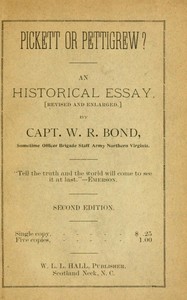
The source record for Pickett or Pettigrew? An Historical Essay — Edition Insights measures this digital text at 29,659 words, 2 hr 9 min estimated reading time, and 8 detected text sections.
The text analysis averages about 21.4 words per sentence, while the detected sections provide another way to judge how the source is divided.
Project Gutenberg metadata also associates the work with “United States -- History -- Civil War, 1861-1865,” connecting these edition facts with the source record’s subject description.
Explore this collection
These alternatives are selected using recorded categories and estimated reading time.
About 128 minutes
Modern Nations
29,374 recorded words. 1 minutes difference from this book's estimate.
View Gutenberg source #35075About 125 minutes
Modern Nations
28,642 recorded words. 4 minutes difference from this book's estimate.
View Gutenberg source #52518About 124 minutes
Modern Nations
28,512 recorded words. 5 minutes difference from this book's estimate.
View Gutenberg source #68392Search stored excerpts and compare books → Choose by your preferences →
Choices use stored catalog measurements. Estimates vary with reading speed. A shared category is a catalog label, not a claim that two books have the same argument or literary quality.
Search reads excerpt text stored with this catalog and links to its associated Gutenberg record. The connection is stored in the site database; this tool does not recheck that every excerpt is word-for-word identical to that external record. Excerpt search does not cover every chapter and does not verify historical publication dates.
Catalog snapshot checked: 2026-09-25. Coverage: 94 public books, 94 available source excerpts.
Calculated from edition completeness, EPUB availability, text structure and catalogue metadata. Not a user rating.
Total of 100 points, scaled to a 2.5-5.0 range. Editions with an empty description or a missing EPUB file are not scored.
Public-domain source text
The source text is kept in the dedicated reader, separate from this catalogue record and its commentary.
W. R. Bond opens his historical essay with a dedication that sets the tone: 'To the memory of the brave men of Hill’s Corps, who were killed while fighting under the orders of General Longstreet, on the afternoon of July 3rd, 1863; whose fame has been clouded by the persistent misrepresentations of certain of their comrades.' From the first page, Bond positions himself as a corrective voice, aiming to restore credit to Pettigrew and his North Carolina troops. The preface reveals that the first edition (1888) preceded the publication of the Official Records, and that Bond incorporated new evidence from those records into this revised edition. He notes that the pamphlet attracted attention from across the country, from Tacoma to Augusta, Maine, suggesting a national readership invested in the controversy.
Bond’s dedication and preface establish the essay’s combative, corrective purpose. He describes the 'slander' against Pettigrew’s men as a 'great wrong' that he seeks to right. The preface also reveals Bond’s method: he combines personal knowledge, testimony from comrades, and statistics from the War Department. He acknowledges that the first edition lacked access to the Official Records, but that this revised edition benefits from them. Bond’s tone is resolute, even defiant, as he writes, 'it is best to “hew to the line and let the chips fall as they may.”' This phrase captures his willingness to challenge established narratives, even at the risk of offending personal friends.
Bond devotes substantial space to the histories of the brigades that fought under Pettigrew: Ramseur’s, Lane’s, and Archer’s. These are not dry lists of engagements; Bond infuses them with personality and moral judgment. Of Ramseur’s brigade, he writes that their 'fondness for prayer meeting and Psalm singing united with an ever readiness to fight, reminds one of Cromwell’s Ironsides.' He notes that the brigade 'fought well at Seven Pines' and 'occupied the bloody lane at Sharpsburg.' Lane’s brigade, he reports, lost 56 percent in the seven days’ fight, and at Chancellorsville suffered 739 killed and wounded. Bond uses these statistics to build a case for the brigade’s courage and sacrifice, implicitly arguing that such men deserve recognition for their role at Gettysburg.
Bond’s account of the July 3 assault focuses on tactical details that support his thesis. He describes the 'point of direction' as 'a small cluster of trees opposite to and in front of Archer’s brigade.' He notes that while the rest of the line dressed on Archer’s brigade, 'four and a half regiments of Lane’s dressed to the left' due to a misunderstanding. This caused them to go beyond the Emmitsburg Road before falling back. Bond emphasizes that Lane’s brigade 'remained fighting till all the rest of the line had given way' and was only withdrawn by General Trimble. He also includes Colonel Frye’s testimony: 'I heard General Pettigrew calling to rally them on the left (referring to a brigade which had just given way).' These details position Pettigrew as a leader actively trying to hold the line, not as a passive participant.
Bond’s essay is best read as a piece of advocacy history, written by a participant with a personal stake in the outcome. Readers should note that Bond’s evidence is selective and his tone partisan; he does not pretend to neutrality. The value of the work lies in its preservation of firsthand accounts and its challenge to a narrative that had already hardened by 1900. For those interested in how the Lost Cause myth was contested from within, Bond’s pamphlet offers a specific, localized counterargument.
I found myself thinking about Bond’s quiet insistence that a name can carry a battle’s whole weight—how one man’s reputation eclipses another’s lived truth. That same ache of forgotten voices lingers in The Old Front Line — Inside the Classic, where the land itself remembers what the records often blur. Strange, how a century later, we’re still sorting the mud from the memory.
Save your reaction, strongest insight, and memorable passage.









