About 440 minutes
The Outlaws of Cave-in-Rock Historical Accounts of the Famous Highwaymen and River Pirates — A Reader’s Guide
Modern Nations
101,022 recorded words. 13 minutes difference from this book's estimate.
View Gutenberg source #61265
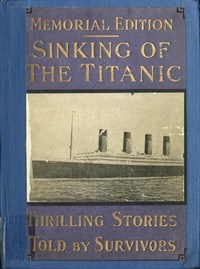
For Sinking of the "Titanic" — Themes and Context, the stored edition analysis reports 104,147 words, 7 hr 33 min estimated reading time, and 13 detected text sections.
The text analysis averages about 16.8 words per sentence, while the detected sections provide another way to judge how the source is divided.
Project Gutenberg metadata also associates the work with “Titanic (Steamship),” connecting these edition facts with the source record’s subject description.
Explore this collection
These alternatives are selected using recorded categories and estimated reading time.
About 440 minutes
Modern Nations
101,022 recorded words. 13 minutes difference from this book's estimate.
View Gutenberg source #61265About 477 minutes
Modern Nations
109,668 recorded words. 24 minutes difference from this book's estimate.
View Gutenberg source #37116About 429 minutes
Modern Nations
98,603 recorded words. 24 minutes difference from this book's estimate.
View Gutenberg source #38774Search stored excerpts and compare books → Choose by your preferences →
Choices use stored catalog measurements. Estimates vary with reading speed. A shared category is a catalog label, not a claim that two books have the same argument or literary quality.
Search reads excerpt text stored with this catalog and links to its associated Gutenberg record. The connection is stored in the site database; this tool does not recheck that every excerpt is word-for-word identical to that external record. Excerpt search does not cover every chapter and does not verify historical publication dates.
Catalog snapshot checked: 2026-09-25. Coverage: 94 public books, 94 available source excerpts.
Calculated from edition completeness, EPUB availability, text structure and catalogue metadata. Not a user rating.
Total of 100 points, scaled to a 2.5-5.0 range. Editions with an empty description or a missing EPUB file are not scored.
Public-domain source text
The source text is kept in the dedicated reader, separate from this catalogue record and its commentary.
Mowbray's account of the Titanic disaster is built almost entirely from the words of survivors, stitched together into a chronological narrative that shifts between the sinking itself, the rescue aboard the Carpathia, and the arrival in New York. The structure is episodic, moving from one voice to another without a single authorial perspective dominating. This approach gives the book a documentary quality, as if the reader is overhearing a series of urgent, fragmented testimonies.
The excerpts reveal a work that is less concerned with technical analysis than with capturing the emotional and sensory details of the catastrophe: the sight of the ship's lights extinguished by waves, the silence of the rescued, the wavering handwriting of a letter written on the Carpathia. The book's power lies in these small, specific observations, not in grand conclusions.
Mowbray does not write a single, continuous narrative. Instead, he assembles a collage of firsthand reports, letters, and interviews. The preface sets a solemn tone, quoting Sir Humphrey Gilbert, but the body of the work quickly gives way to the voices of survivors. The letter from Dr. Alice Leeder, for instance, is reproduced in full, with Mowbray noting the wavering handwriting as evidence of her state of mind. The Rev. P. M. A. Hoque's account describes the rescue in stark, almost clinical terms: “Not a word was spoken by any one of the rescued or the rescuers.” These multiple perspectives create a layered, sometimes contradictory picture of events, avoiding a single authoritative version.
Two images recur across the excerpts: light and silence. Dr. Leeder writes of the lights burning until extinguished by the waves, a detail that appears in several accounts. The rescue scene is marked by an absence of speech—Hoque emphasizes that no one spoke, and that the women were less excited than the men, their eyes red and swollen but tearless. This silence is not calm but a kind of shock, a numbing that Mowbray lets stand without commentary. The contrast between the brilliant, doomed ship and the mute, drifting survivors becomes a structural motif, reinforcing the sense of a world turned unreal.
The narrative moves restlessly between locations: the sinking Titanic, the Carpathia, the pier in New York. The excerpts show a careful attention to transitions—the moment of transfer from lifeboat to rescue ship, the docking, the reunion with relatives. A young man is met at the pier by a cousin; they go to the Waldorf-Astoria. These small, concrete details anchor the catastrophe in ordinary geography. The book does not linger in the abstract; it follows survivors from the scene of the disaster into the aftermath, tracing the physical journey that mirrors their psychological dislocation.
Mowbray treats written documents as evidence. The letter from Dr. Leeder is presented as a primary source, its wavering handwriting noted as a clue to her state of mind. The book also includes a letter from a survivor to a friend in Philadelphia, and the preface itself is a kind of formal document. This reliance on written testimony gives the work a legalistic flavor, as if Mowbray is building a case from depositions. Yet the documents are also intensely personal, full of details about lost clothing and borrowed hats. The tension between the public record and private grief is a quiet undercurrent throughout the excerpts.
Readers should approach this book as a collection of primary sources rather than a polished history. The shifts in voice and perspective can be disorienting, but they also preserve the rawness of the event. Pay attention to the small details—the French-speaking children, the orchestra playing to the end—that Mowbray lets speak for themselves. The book's value lies not in its analysis but in its fidelity to the fragmented, overwhelming experience of the survivors.
Hey, I keep thinking about that Titanic survivor book—how ordinary people become extraordinary in a single night, their quiet choices echoing forward. It reminded me, strangely, of A History of the Nineteenth Century, Year by Year. Volume 2 (of 3) — Context and Discussion, where every small decision across decades slowly shapes everything. Both left me feeling the weight of moments we never see coming. Weird how that stays with you.
Your answers remain private and are stored only in this browser.









