About 51 minutes
Food in War Time — Context and Discussion
Modern Nations
11,674 recorded words. 1 minutes difference from this book's estimate.
View Gutenberg source #32472
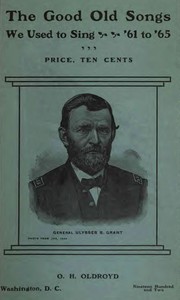
For The Good Old Songs We Used to Sing, '61 to '65 — Inside the Classic, the stored edition analysis reports 11,302 words, 50 min estimated reading time, and 3 detected text sections.
The text analysis averages about 17.9 words per sentence, while the detected sections provide another way to judge how the source is divided.
Project Gutenberg metadata also associates the work with “War songs -- United States,” connecting these edition facts with the source record’s subject description.
Explore this collection
These alternatives are selected using recorded categories and estimated reading time.
About 51 minutes
Modern Nations
11,674 recorded words. 1 minutes difference from this book's estimate.
View Gutenberg source #32472About 42 minutes
Modern Nations
9,573 recorded words. 8 minutes difference from this book's estimate.
View Gutenberg source #68095About 67 minutes
Modern Nations
15,184 recorded words. 17 minutes difference from this book's estimate.
View Gutenberg source #69537Search stored excerpts and compare books → Choose by your preferences →
Choices use stored catalog measurements. Estimates vary with reading speed. A shared category is a catalog label, not a claim that two books have the same argument or literary quality.
Search reads excerpt text stored with this catalog and links to its associated Gutenberg record. The connection is stored in the site database; this tool does not recheck that every excerpt is word-for-word identical to that external record. Excerpt search does not cover every chapter and does not verify historical publication dates.
Catalog snapshot checked: 2026-09-25. Coverage: 94 public books, 94 available source excerpts.
Calculated from edition completeness, EPUB availability, text structure and catalogue metadata. Not a user rating.
Total of 100 points, scaled to a 2.5-5.0 range. Editions with an empty description or a missing EPUB file are not scored.
Public-domain source text
The source text is kept in the dedicated reader, separate from this catalogue record and its commentary.
Osborn H. Oldroyd's The Good Old Songs We Used to Sing, '61 to '65 (1902) is a compact songbook that presents lyrics from the Civil War era without extensive commentary. The title's phrase "we used to sing" signals a retrospective, personal framing: these are songs recalled by a veteran, not a historian. The collection includes well-known anthems like "The Star Spangled Banner" and "Battle Hymn of the Republic" alongside dialect songs such as "Kingdom Coming" and sentimental pieces like "The Vacant Chair." Each entry is accompanied by a musical notation link and, in some cases, a brief headnote identifying a general or a unit. The book's structure—a simple list of titles followed by lyrics—emphasizes the songs themselves, while the occasional interjection of a portrait or a note on a battle hints at a narrative voice that is present but restrained.
Oldroyd's editorial presence is felt not in lengthy introductions but in small, telling choices. The dedication "To the Veterans of the War of the Rebellion" sets a tone of shared experience. The headnotes are terse: "MAJ. GEN'L W.T. SHERMAN" appears above "Sherman's March to the Sea," and "BRIG. GEN. JOHN M'ARTHUR" precedes "Kingdom Coming." These attributions link each song to a specific military figure, implying that the songs were sung by or associated with those commanders' troops. The inclusion of a photograph of General Grant from 1864 and an image of shrapnel containing musket balls adds a material, almost scrapbook-like quality. The brevity of these notes—often just a name and rank—suggests that Oldroyd assumed his readers would recognize the references without explanation. This editorial restraint creates a sense of intimacy: the book is a memento for those who already know the stories behind the songs.
The collection moves between distinct registers, from formal patriotic verse to colloquial dialect and sentimental balladry. "The Star Spangled Banner" and "Hail Columbia" employ elevated, declarative language, while "Kingdom Coming" uses African American dialect for comic effect: "I 'spects he'll try an' fool dem Yankees / For to tink he's contraband." This juxtaposition reflects the range of experiences and attitudes within the Union army. The sentimental songs, such as "The Vacant Chair" and "Who Will Care for Mother Now," adopt a plaintive, personal tone, focusing on loss and longing. "Tramp, Tramp, Tramp" shifts to a prisoner's perspective, with the repeated chorus "Tramp, tramp, tramp, the boys are marching" creating a rhythmic, almost hypnotic effect. These shifts in voice are not annotated; Oldroyd lets the lyrics speak for themselves, leaving readers to notice the contrasts in tone and perspective.
Many songs in the collection rely on repetitive choruses that would have been easy to learn and sing in a group. "When Johnny Comes Marching Home" repeats "Hurrah, hurrah!" after each line of the verse, building anticipation. "Tramp, Tramp, Tramp" uses its title phrase as a rhythmic anchor, mimicking the sound of marching feet. The chorus of "The Vacant Chair" returns after each verse, reinforcing the theme of absence. This structural repetition gives the collection a consistent pacing: each song builds to a familiar refrain, then moves on. The brevity of the songs—most are two to four verses—keeps the momentum brisk. Oldroyd does not interrupt with commentary, so the reader experiences the songs as a sequence of performances, each with its own internal rhythm. The result is a reading experience that mirrors the communal, call-and-response nature of campfire singing.
Readers approaching this collection should attend to the gaps between the songs. The headnotes name generals but rarely explain the battles or contexts; the dialect songs are presented without editorial framing. This spare presentation invites readers to consider what the original audience would have known—and what has been lost. The book is best read as a veteran's keepsake, not a comprehensive history. Listening to the linked MIDI files, where available, can restore some of the oral dimension that the printed page cannot convey.
There’s something tender about Oldroyd’s songbook, each tune a veteran’s quiet nod to a shared past. It made me think how all history feels personal when held this way. I stumbled on Three Frenchmen in Bengal The Commercial Ruin of the French Settlements in 1757 — Reading Notes afterward, and the same ache surfaced—empires fading, not in headlines but in small, human losses. Old songs, old losses—both just echo.
Save your reaction, strongest insight, and memorable passage.









