About 349 minutes
The Women of The American Revolution, Vol. 2 — Inside the Classic
Modern Nations
80,214 recorded words. 1 minutes difference from this book's estimate.
View Gutenberg source #49412
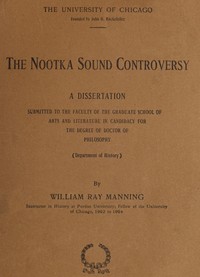
The source record for The Nootka Sound Controversy: A dissertation — Text and Context measures this digital text at 79,930 words, 5 hr 48 min estimated reading time, and 14 detected text sections.
The text analysis averages about 20.3 words per sentence, while the detected sections provide another way to judge how the source is divided.
Project Gutenberg metadata also associates the work with “Thesis (Ph. D.),” connecting these edition facts with the source record’s subject description.
Explore this collection
These alternatives are selected using recorded categories and estimated reading time.
About 349 minutes
Modern Nations
80,214 recorded words. 1 minutes difference from this book's estimate.
View Gutenberg source #49412About 345 minutes
Modern Nations
79,349 recorded words. 3 minutes difference from this book's estimate.
View Gutenberg source #47332About 372 minutes
Modern Nations
85,400 recorded words. 24 minutes difference from this book's estimate.
View Gutenberg source #42892Search stored excerpts and compare books → Choose by your preferences →
Choices use stored catalog measurements. Estimates vary with reading speed. A shared category is a catalog label, not a claim that two books have the same argument or literary quality.
Search reads excerpt text stored with this catalog and links to its associated Gutenberg record. The connection is stored in the site database; this tool does not recheck that every excerpt is word-for-word identical to that external record. Excerpt search does not cover every chapter and does not verify historical publication dates.
Catalog snapshot checked: 2026-09-25. Coverage: 94 public books, 94 available source excerpts.
Calculated from edition completeness, EPUB availability, text structure and catalogue metadata. Not a user rating.
Total of 100 points, scaled to a 2.5-5.0 range. Editions with an empty description or a missing EPUB file are not scored.
Public-domain source text
The source text is kept in the dedicated reader, separate from this catalogue record and its commentary.
Manning opens his dissertation by stating that historians have neglected the Nootka Sound incident, and that most accounts rely on partisan pamphlets. He promises a more extended account drawn largely from unpublished sources, and he delivers on that promise by citing documents from archives in Seville, Madrid, London, Paris, and Washington. The preface alone establishes his method: he worked with his wife, transcribed over 500 pages of unpublished documents, and organized a classified bibliography to clarify sources and their relative value.
Manning’s prose is shaped by his reliance on manuscript evidence. He repeatedly uses phrases like “unpublished documents,” “thorough search,” and “transcribed and used” to signal his authority. In the preface, he thanks his wife for working with him “continually,” a rare personal note that underscores the labor of archival research. The text is dense with references to specific repositories—the Archives of the Indies, the British Museum, the Public Record Office—and Manning often contrasts his findings with earlier printed accounts. For example, he notes that the only difference between the British Cabinet’s drafts and the final signed declarations is the insertion of a clause about reciprocal treatment, a detail he likely gleaned from manuscript comparison. This attention to textual variants gives the narrative a forensic quality.
The excerpts include the full text of the Spanish declaration and the British counter-declaration of July 24, 1790. Manning reproduces these documents verbatim, allowing readers to see the careful phrasing: Spain agrees to give satisfaction “fully persuaded that His said Britannic Majesty would act in the same manner,” while Britain accepts the declaration as “full and entire satisfaction.” Manning’s commentary is minimal; he lets the documents speak. He notes that Fitzherbert, the British ambassador, reported the Spanish king’s rare personal conversation about the declarations, quoting the ambassador’s observation that the king spoke with “marked cordiality.” This blend of official text and diplomatic report shows Manning’s interest in both the formal language of state and the informal cues of personal interaction.
Manning organizes the monograph into fourteen chapters that move from the introduction through the English and Spanish plans, the seizure at Nootka, the prisoners in Mexico, the European war scare, and the final settlement. The chapter titles are declarative and chronological: “Martinez’s operations at Nootka before Colnett’s arrival,” “The quarrel and the seizure,” “England’s first demand granted.” This structure reflects a historian’s desire to trace cause and effect. The preface states that the purpose is to “correct as many of the errors as possible,” and the chapter sequence suggests a step-by-step unraveling of diplomatic moves. Manning does not impose a thesis; he lets the events unfold, with each chapter building on the previous one. The bibliography, placed at the end, is classified by type (manuscripts, printed documents, secondary works), reinforcing the scholarly apparatus.
Manning’s authorial voice is measured and impartial. He describes the Spanish declaration as settling “merely the question of satisfaction,” and he notes that the British Cabinet’s drafts were altered only slightly. He does not praise or condemn either side. When he quotes Fitzherbert’s report of the Spanish king’s cordiality, he includes the ambassador’s caveat that such conversation was “extremely unusual.” This restraint is consistent with his stated goal of correcting partisan errors. The prose is plain, with few adjectives; the focus is on what the documents say. Manning’s own judgments are rare and cautious, as when he writes that the declarations “settled merely the question of satisfaction,” implying that the larger dispute over rights remained unresolved. This understatement is a deliberate rhetorical choice, avoiding the bombast of contemporary pamphlets.
Manning’s dissertation is best read with attention to the documents he reproduces and the archives he cites. The narrative moves quickly through diplomatic exchanges, but the real substance lies in the footnotes and the bibliography. Readers interested in the mechanics of eighteenth-century diplomacy will find a model of archival research, while those seeking dramatic storytelling may need to supply their own context. The work remains a useful corrective to earlier partisan accounts, precisely because Manning lets the sources—and their silences—guide the argument.
There is a quiet kinship between Manning's patient untangling of the Nootka Sound dispute and the hushed, weary voices gathered in The Inside Story of the Peace Conference — Reading Notes. Both books breathe the same air—that of diplomats speaking precisely, hoping their careful words might hold back the tide of something larger than themselves.
Build a private reading journal entry for this title.









