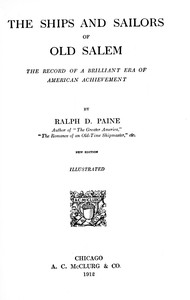
The ships and sailors of old Salem — Text and Context

(0 User reviews)   1776
In Category - Social History
Paine, Ralph Delahaye, 1871-1925 Project Gutenberg 2024 Not confirmed
Ships -- Massachusetts -- Salem -- History; Sailors -- Massachusetts -- Salem -- History; Salem (Mass.) -- History; Salem (Mass.) -- History, Naval; Shipping -- Massachusetts -- Salem -- History Readers of public-domain and historical texts
Project Gutenberg digital edition en

Edition facts

Words 172,675
Reading time 751 min
Text sections 40

The source record for The ships and sailors of old Salem — Text and Context measures this digital text at 172,675 words, 12 hr 31 min estimated reading time, and 40 detected text sections.

The text analysis averages about 26.3 words per sentence, while the detected sections provide another way to judge how the source is divided.

Project Gutenberg metadata also associates the work with “Ships -- Massachusetts -- Salem -- History,” connecting these edition facts with the source record’s subject description.

Explore this collection

Compare your next read

These alternatives are selected using recorded categories and estimated reading time.

Search stored excerpts and compare books → Choose by your preferences →

How these choices and excerpts are prepared

Choices use stored catalog measurements. Estimates vary with reading speed. A shared category is a catalog label, not a claim that two books have the same argument or literary quality.

Search reads excerpt text stored with this catalog and links to its associated Gutenberg record. The connection is stored in the site database; this tool does not recheck that every excerpt is word-for-word identical to that external record. Excerpt search does not cover every chapter and does not verify historical publication dates.

Catalog snapshot checked: 2026-09-25. Coverage: 94 public books, 94 available source excerpts.

Ralph D. Paine's 1908 history of Salem's merchant fleet uses firsthand accounts—like a young sailor's 1801 journal of Japan—to show how Yankee enterprise, seamanship, and risk-taking built a global trade network, despite British restrictions, pirates, and uncharted seas.
Share
Editorial Edition Score 4.9/5

Calculated from edition completeness, EPUB availability, text structure and catalogue metadata. Not a user rating.

How this score is calculated
  • Description quality20 pts
  • Title & short description10 pts
  • Source metadata20 pts
  • Text length15 pts
  • Chapters / structure15 pts
  • EPUB file integrity20 pts

Total of 100 points, scaled to a 2.5-5.0 range. Editions with an empty description or a missing EPUB file are not scored.

Edition quality

Public-domain source text

Read the source text

The source text is kept in the dedicated reader, separate from this catalogue record and its commentary.

Ralph D. Paine opens his history of Salem's maritime heyday not with a dry chronicle of tonnage and routes, but with a sailor's journal from 1801, describing a visit to Japan aboard the ship Margaret. The excerpt records Japanese customs—men wearing hair “turned up on top of the head in a little club,” women in long gowns, and a festival where paper lanterns are set adrift in “small straw barques with paper sails.” This is not a general survey of Salem shipping; it is a specific, eyewitness account that Paine uses to ground his narrative in lived experience. The catalog subjects list “Ships -- Massachusetts -- Salem -- History” and “Sailors -- Massachusetts -- Salem -- History,” but the excerpts reveal that the book is less a statistical record than a collection of stories, letters, and logs that illustrate the character of the men and the risks they took.

Eyewitness Japan: A Salem Sailor's 1801 Journal

The longest excerpt in the provided text is a first-person narrative from a young American aboard the Margaret at Nagasaki. It describes Japanese dress, the “fast” for the dead, and the loading of lacquerware and porcelain for the return cargo. The sailor notes that the East India Company’s ships were already loading, and that all vessels had to depart on a fixed date “no matter whether it blew high or low.” This passage is valuable because it shows how Paine weaves primary sources into his account—he does not simply summarize Salem’s trade with Japan, but lets a participant speak. The catalog subject “Salem (Mass.) -- History, Naval” is thus realized through personal testimony, not just fleet lists.

The Risks Beyond the Sea: Pirates, Privateers, and British Restrictions

Paine’s preface to the second edition (1912) frames the book as a lesson for a nation that had lost its merchant marine. He lists the obstacles Salem’s sailors faced: “uncharted, unlighted coasts,” “ferocious pirates,” and “the policy of England which deliberately endeavored to crush Colonial shipping.” The excerpts do not provide full chapters on these topics, but the preface makes clear that the book will detail how Salem’s ships succeeded “without counting the odds.” The catalog subject “Shipping -- Massachusetts -- Salem -- History” is thus presented as a story of overcoming adversity, not a dry economic analysis. Paine’s language is direct: “It was a merciless jealousy that sought to confiscate every Yankee merchant vessel.”

From Logbooks to Lessons: How Paine Uses Evidence

The excerpts show that Paine relies heavily on original documents—journals, letters, and logs—rather than secondary synthesis. The Japan passage is introduced as “one of the first Americans that ever invaded Japan with a note-book,” and the text includes verbatim entries. This method gives the book a documentary feel, but it also means that the narrative is shaped by what survives. The catalog subjects imply a comprehensive history, but the excerpts suggest a more episodic structure, focused on dramatic incidents. Readers should expect vivid set-pieces—like the Japanese festival or the Russian sloop incident—rather than a continuous timeline. Paine’s preface explicitly connects these stories to contemporary concerns about American shipping, but the excerpts themselves are mostly narrative, not argumentative.

Paine’s book is best approached as a collection of maritime narratives anchored in primary sources, not as a systematic economic history. Readers interested in the texture of early American seafaring—the customs of foreign ports, the dangers of privateers, the daily life of sailors—will find rich material. Those seeking a comprehensive analysis of Salem’s trade patterns or shipbuilding techniques may need to supplement this volume with other works. The preface’s call for a revived merchant marine is a framing device; the heart of the book lies in the logs and letters of the men who sailed.

The rain kept time with the creaking of old Salem’s rigging, and I lingered on that young sailor’s 1801 journal, his awe at Japan’s closed harbors so vivid. It made me wonder how a foreigner’s eyes see our own shores. That’s how I stumbled upon Aristocracy in America. From the sketch-book of a German nobleman. vol. 1 (of 2) — Inside the Classic, another stranger’s careful looking, a quiet counterpoint to Paine’s salt-stained certainty.

There are no reviews for this eBook.

0
0 out of 5 (0 User reviews )

Add a Review

Your Rating *
There are no comments for this eBook.

Reader reflection

Your personal reading reflection

Build a private reading journal entry for this title.

Your progress 0 / 10
1

Where are you in your reading?

2

Did this book hold your interest?

3

Would you pass this book on to a friend?

4

How easy was the book to follow?

Related eBooks