About 429 minutes
Oregon and Eldorado; or, Romance of the Rivers — Inside the Classic
Modern Nations
98,603 recorded words. 2 minutes difference from this book's estimate.
View Gutenberg source #38774
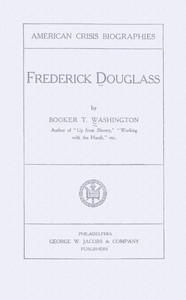
Frederick Douglass — Inside the Classic can be approached with a clearer sense of reading commitment from its source measurements: 98,182 words, 7 hr 7 min estimated reading time, and 23 detected text sections.
The text analysis averages about 21.2 words per sentence, while the detected sections provide another way to judge how the source is divided.
Project Gutenberg metadata also associates the work with “Douglass, Frederick, 1818-1895,” connecting these edition facts with the source record’s subject description.
Explore this collection
These alternatives are selected using recorded categories and estimated reading time.
About 429 minutes
Modern Nations
98,603 recorded words. 2 minutes difference from this book's estimate.
View Gutenberg source #38774About 440 minutes
Modern Nations
101,022 recorded words. 13 minutes difference from this book's estimate.
View Gutenberg source #61265About 453 minutes
Modern Nations
104,147 recorded words. 26 minutes difference from this book's estimate.
View Gutenberg source #73984Search stored excerpts and compare books → Choose by your preferences →
Choices use stored catalog measurements. Estimates vary with reading speed. A shared category is a catalog label, not a claim that two books have the same argument or literary quality.
Search reads excerpt text stored with this catalog and links to its associated Gutenberg record. The connection is stored in the site database; this tool does not recheck that every excerpt is word-for-word identical to that external record. Excerpt search does not cover every chapter and does not verify historical publication dates.
Catalog snapshot checked: 2026-09-25. Coverage: 94 public books, 94 available source excerpts.
Calculated from edition completeness, EPUB availability, text structure and catalogue metadata. Not a user rating.
Total of 100 points, scaled to a 2.5-5.0 range. Editions with an empty description or a missing EPUB file are not scored.
Public-domain source text
The source text is kept in the dedicated reader, separate from this catalogue record and its commentary.
Booker T. Washington’s Frederick Douglass (1906) opens with a preface that frames the subject within the “American Crisis Biographies” series, a project designed to offer impartial accounts of the Civil War era by pairing Northern and Southern writers with their respective subjects. Washington, a former slave turned educator, writes from a unique vantage: he is both a biographer and a living embodiment of the post-emancipation trajectory Douglass helped forge. The preface’s language—referring to “primitive black people from Africa” and “the most enlightened race”—immediately signals the racial assumptions of its time, while also revealing Washington’s strategic accommodationism. This tension between deference and advocacy permeates the narrative, shaping how Douglass’s militancy is presented.
Washington’s prose oscillates between detached chronicle and personal investment. In recounting Douglass’s flight to England after John Brown’s raid, he writes that Douglass “was fairly pushed into Canada by his friends,” then notes the refusal of a passport by the American minister on the grounds that Douglass “was not a citizen of the United States.” The factual tone belies the indignity of the denial. Washington often lets events speak for themselves, but his word choices—such as describing the Fugitive Slave Law as having “seemed for a time to put an end to all hopes for further rescues”—carry a quiet urgency. This dual register reflects Washington’s own position as a public figure navigating white expectations while advancing Black progress.
The chapter “Forebodings of the Crisis” compresses the decade 1850–1860 into a swift, almost breathless catalog of setbacks: the Fugitive Slave Law, the Dred Scott Decision, the Kansas-Nebraska Bill, and John Brown’s raid. Washington writes that these events “appeared to have set the goal of emancipation ever farther out of the range of practical possibilities,” then pivots to argue that the pro-slavery victory was “more apparent than real.” The rhythm—short declarative sentences followed by longer analytical ones—creates a sense of mounting tension and release. This structural choice mirrors the historical acceleration toward war, while also allowing Washington to insert his own interpretive gloss: that deeper currents were “running counter” to slavery’s triumph.
One of the most telling episodes in the excerpts is Douglass’s application for a passport to visit Paris. Washington reports the refusal by George M. Dallas, the American minister, “on the ground that he was not a citizen of the United States.” The brevity of the account—a single sentence—contrasts with the longer descriptions of Douglass’s speaking tours and the Harper’s Ferry aftermath. This asymmetry highlights a recurring pattern: Washington devotes more space to Douglass’s public influence than to the legal humiliations he endured. The passport denial, though understated, serves as a quiet indictment of the nation’s failure to recognize Black citizenship, a theme that resonates with Washington’s own advocacy for industrial education and gradual rights.
Readers attentive to narrative voice will notice how Washington’s biography of Douglass is also a self-portrait of the author’s era. The book’s pacing—alternating between sweeping historical summaries and tight, anecdotal scenes—reflects the pressures of writing about a radical figure while maintaining a conciliatory public stance. For those interested in the interplay between biographer and subject, this work offers a layered study of how one generation of Black leadership interpreted another.
Sometimes a book stays with you less for its facts and more for the quiet weight of its hope. Washington’s portrait of Douglass carries that strange tenderness—a leader seeing another leader’s struggle as his own. I felt something similar in Ten Years Near the German Frontier: A Retrospect and a Warning — Edition Insights, where memory becomes a gentle, honest companion rather than a lesson. It lingers like an old friend’s paused thought.
Answer a few questions and save a private reflection on this device.









