
The life of John Thompson, a fugitive slave — A Closer Reading

(0 User reviews)   726
In Category - Modern Nations
Thompson, John, 1812-1860 Project Gutenberg 2023 Not confirmed
Fugitive slaves -- United States -- Biography; African Americans -- Biography; Enslaved persons -- Maryland -- Biography; Worcester (Mass.) -- Biography; Thompson, John, 1812-1860; Slavery -- Maryland -- History -- 19th century Readers of public-domain and historical texts
Project Gutenberg digital edition en

Edition facts

Words 40,032
Reading time 175 min
Text sections 24

For The life of John Thompson, a fugitive slave — A Closer Reading, the stored edition analysis reports 40,032 words, 2 hr 55 min estimated reading time, and 24 detected text sections.

The text analysis averages about 23.4 words per sentence, while the detected sections provide another way to judge how the source is divided.

Project Gutenberg metadata also associates the work with “Fugitive slaves -- United States -- Biography,” connecting these edition facts with the source record’s subject description.

Explore this collection

Compare your next read

These alternatives are selected using recorded categories and estimated reading time.

Search stored excerpts and compare books → Choose by your preferences →

How these choices and excerpts are prepared

Choices use stored catalog measurements. Estimates vary with reading speed. A shared category is a catalog label, not a claim that two books have the same argument or literary quality.

Search reads excerpt text stored with this catalog and links to its associated Gutenberg record. The connection is stored in the site database; this tool does not recheck that every excerpt is word-for-word identical to that external record. Excerpt search does not cover every chapter and does not verify historical publication dates.

Catalog snapshot checked: 2026-09-25. Coverage: 94 public books, 94 available source excerpts.

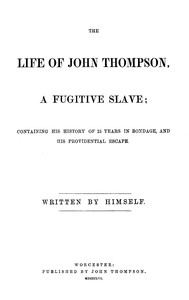
John Thompson's 1856 narrative recounts his 25 years enslaved in Maryland and his escape to freedom. Written by himself, the memoir details plantation life, family separation, and the psychological toll of bondage, culminating in a providential flight aided by faith and a fellow fugitive.
Share
Editorial Edition Score 4.8/5

Calculated from edition completeness, EPUB availability, text structure and catalogue metadata. Not a user rating.

How this score is calculated
  • Description quality20 pts
  • Title & short description10 pts
  • Source metadata20 pts
  • Text length15 pts
  • Chapters / structure15 pts
  • EPUB file integrity20 pts

Total of 100 points, scaled to a 2.5-5.0 range. Editions with an empty description or a missing EPUB file are not scored.

Edition quality

Public-domain source text

Read the source text

The source text is kept in the dedicated reader, separate from this catalogue record and its commentary.

John Thompson opens his 1856 narrative by situating himself within a specific Maryland plantation hierarchy: born in 1812 on the estate of Mrs. Wagar, he notes that her son James H. managed roughly two hundred enslaved people, fifty of whom belonged to him and the rest to his mother. This precise accounting of human property—a ledger-like detail—immediately establishes the dehumanizing calculus of slavery. Thompson also records the ages of the master's children and the division of labor among his own family: his parents worked as field hands, while his younger sister served as a house girl. These early observations ground the memoir in concrete social structures rather than abstract lament.

The Weight of Numbers and Naming

Thompson repeatedly quantifies the enslaved population, noting that the plantation held “about two hundred slaves, young and old.” This numerical precision recurs throughout the excerpts, as when he later reports that “three hundred dollars had been offered for me” after his escape. The dollar figure transforms his person into a commodity with a fixed price, a motif that underscores the economic logic of bondage. Thompson also names individuals sparingly—his parents, his sister, the master’s children—but the enslaved majority remain anonymous, a silence that reflects the archival erasure of their lives. By recording these numbers and names, Thompson pushes back against that erasure, insisting on the humanity of those counted as property.

Faith as a Navigational Tool

Thompson’s escape narrative is interwoven with religious language that functions as both solace and strategy. He describes spending “one comfortable week, in solemn meditation and sweet communion with God” in a hiding place, and later makes a “third covenant with God” before fleeing, citing the proverb that “a threefold cord is not easily broken.” His trust in divine guidance compensates for his ignorance of geography: “The most discouraging thing seemed my ignorance of the direction I ought to pursue.” Unable to ask a white man for directions, he relies on prayer and a “Great Conductor.” This spiritual framework is not mere piety; it is a practical tool for navigating a landscape where every white person is a potential betrayer.

Improvisation and the Material World

When Thompson and his companion steal horses for their escape, they lack bridles and are forced to improvise: “we cut grape vines, made for ourselves bridles.” This moment of resourcefulness—turning to “nature’s manufactory”—echoes earlier details of plantation life, where enslaved people had to fashion tools and clothing from scant materials. The episode also reveals the constant threat of detection: they are “routed and chased some distance by the faithful watch dogs of the farm.” Thompson’s narrative is filled with such material details—horses, blankets, vines, dogs—that ground his flight in the physical world. His escape is not a triumphant dash but a series of makeshift solutions, each one precarious and contingent.

Thompson’s memoir, published in Worcester in 1856, is notable for its understated tone and its attention to the mundane logistics of survival. Readers should attend to the gaps in the narrative—the unnamed fellow slaves, the unrecorded years—as much as to the events he chooses to recount. The preface reveals that Thompson wrote partly because few Maryland fugitives had published their stories, making this a rare testimony from a specific region. His voice, measured and precise, offers a counterpoint to more dramatic slave narratives, emphasizing the quiet endurance of daily life under bondage and the calculated risks of flight.

John Thompson's voice stayed with me long after I finished—that quiet ache of a man counting years like stones. It made me think of A Relic of the Revolution — Reading Companion, how certain objects hold whole lifetimes of longing. I keep circling back to that feeling: what it means to carry memory in your chest, waiting for someone to hear it.

There are no reviews for this eBook.

0
0 out of 5 (0 User reviews )

Add a Review

Your Rating *
There are no comments for this eBook.

Reader reflection

How will you remember this book?

Save your reaction, strongest insight, and memorable passage.

Your progress 0 / 10
1

Have you finished this book?

2

How much did you enjoy the reading experience?

3

Is this a title you would suggest to others?

4

What was the reading difficulty like?

Related eBooks









