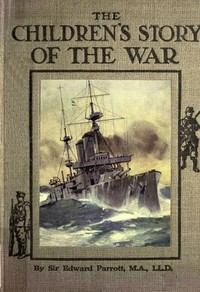
Sir Edward Parrott opens this third volume of his wartime series for children with a striking image: the last British soldier detraining in Artois, mud from the Aisne trenches still clinging to his tunic. The authorial voice is immediate and concrete, anchoring the narrative in physical details that evoke the recent past. Parrott does not merely summarize events; he selects moments that dramatize the war for a juvenile audience, such as the daring air raid on the Zeppelin factory at Friedrichshafen or the rescue of Lieutenant Colebrook by Bandsman Rendle, who “wormed his way across the open space on his stomach.” These episodes are rendered in a style that blends reportage with moral clarity, often quoting soldiers directly to lend authenticity.
Diction and the Rhetoric of Duty
Parrott’s word choices consistently reinforce a code of stoic heroism. In the account of Naik Darwan Sing Negí, the language is precise and understated: “though wounded in two places in the head and also in the arm, he fought on.” The repetition of fought on without embellishment mirrors the plainspoken valor Parrott wishes to instill. Similarly, Lieutenant de Pass “entered a German sap and destroyed a traverse in the face of the enemy’s bombs.” The phrase in the face of recurs as a structural marker of courage. Parrott avoids abstract nouns like bravery; instead, he lets actions speak. The quoted soldier’s account of being “buried with mud” by a shell uses a passive construction that emphasizes the soldier’s helplessness, yet the narrative immediately pivots to Rendle’s initiative. This juxtaposition of vulnerability and resourcefulness is a deliberate rhetorical pattern.
Voice in Soldier Quotations
The excerpts include first-person testimony that Parrott weaves into his prose. The unnamed soldier who describes the rescue of Lieutenant Colebrook uses colloquial, direct language: “I thought this was a bit too much, so I said that Colebrook must be got away.” The phrase a bit too much is strikingly informal for a 1916 children’s book, suggesting Parrott valued authenticity over polish. He preserves the soldier’s rhythm—short, declarative sentences punctuated by understatement. In contrast, Parrott’s own narrative voice is more formal, employing periodic sentences and elevated diction: “Great was the naik’s delight when his Majesty himself pinned the cross to his breast.” This shift between registers creates a layered reading experience: the young reader hears both the official historian and the man in the trench.
Description of Landscape and Technology
Parrott’s descriptive passages are economical but evocative. The opening image of soldiers detraining “within fifty miles of the white cliffs” connects the front to a familiar landmark, making distance tangible. In the air-raid account, he specifies “three British aeroplanes flew from France across the mountains into Germany, a distance of 250 miles.” The precise number and distance lend credibility. Later, the description of trench warfare includes technical terms like traverse and sap, which Parrott explains in footnotes (e.g., “[119] a sap is a narrow trench dug to approach the enemy’s position”). This pedagogical impulse is consistent: he wants his readers to understand the mechanics of war. Yet he never lingers on horror; the focus remains on action and outcome.
Structure and the Juxtaposition of Front and Home
The volume’s structure alternates between battle narratives and broader contextual chapters, such as “Germany’s Colonial Empire.” Parrott uses this juxtaposition to explain why the war extends beyond Europe. In the colonial chapter, his diction shifts to economic and political reasoning: “Germany had become a great manufacturing nation, and she needed new markets.” The tone is explanatory, not jingoistic. He also includes verse—the opening poem by I. Gregory Smith—which frames the soldier’s experience in terms of schoolboy play and prayer. This blend of genres (poetry, reportage, history) reflects Parrott’s assumption that children need varied entry points. The footnotes, too, are part of the structure: they define terms like naik (a corporal) and sap, treating the reader as a capable learner.
Parrott’s editorial choices—the use of soldier testimony, the careful explanation of military terms, the alternation between frontline action and global context—reveal a writer who trusted his young audience to grasp complexity. Readers should attend to the footnotes and the quoted voices, which often carry more emotional weight than the surrounding prose. The volume is best approached as a deliberate artifact of wartime pedagogy, where every stylistic decision serves to make distant events immediate and morally legible.
That rainy afternoon, ten years old, I read about the Indian cavalry at Ypres and felt the strange intimacy of distant battles. But it was the quieter sadness—the Emden sinking, a colony falling—that stayed with me. Later, flipping through a forgotten shelf, I found The Border and the Buffalo: An Untold Story of the Southwest Plains The Bloody Border of Missouri and Kansas. The Story of the Slaughter of the Buffalo. Westward among the — A Reader’s Guide, and that same sense of a doomed, vanished world settled over me again.