About 215 minutes
Gallipoli — A Closer Reading
World Events
49,230 recorded words. 15 minutes difference from this book's estimate.
View Gutenberg source #53682
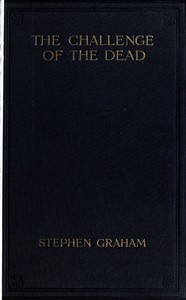
The challenge of the dead — Background and Themes can be approached with a clearer sense of reading commitment from its source measurements: 45,844 words, 3 hr 20 min estimated reading time, and 5 detected text sections.
The text analysis averages about 19.2 words per sentence, while the detected sections provide another way to judge how the source is divided.
Project Gutenberg metadata also associates the work with “World War, 1914-1918,” connecting these edition facts with the source record’s subject description.
Explore this collection
These alternatives are selected using recorded categories and estimated reading time.
About 215 minutes
World Events
49,230 recorded words. 15 minutes difference from this book's estimate.
View Gutenberg source #53682About 217 minutes
World Events
49,896 recorded words. 17 minutes difference from this book's estimate.
View Gutenberg source #52679About 223 minutes
World Events
51,077 recorded words. 23 minutes difference from this book's estimate.
View Gutenberg source #46186Search stored excerpts and compare books → Choose by your preferences →
Choices use stored catalog measurements. Estimates vary with reading speed. A shared category is a catalog label, not a claim that two books have the same argument or literary quality.
Search reads excerpt text stored with this catalog and links to its associated Gutenberg record. The connection is stored in the site database; this tool does not recheck that every excerpt is word-for-word identical to that external record. Excerpt search does not cover every chapter and does not verify historical publication dates.
Catalog snapshot checked: 2026-09-25. Coverage: 94 public books, 94 available source excerpts.
Calculated from edition completeness, EPUB availability, text structure and catalogue metadata. Not a user rating.
Total of 100 points, scaled to a 2.5-5.0 range. Editions with an empty description or a missing EPUB file are not scored.
Public-domain source text
The source text is kept in the dedicated reader, separate from this catalogue record and its commentary.
Stephen Graham's The Challenge of the Dead opens not with a battle but with a seaside promenade: Zeebrugge Mole in 1920, where German guns with burst barrels stand beside a beer stand and schoolchildren in crocodile formation. The scene is sun-drenched, wind-swept, and eerily ordinary. Graham immediately establishes a tension between the monumental scale of war's aftermath and the triviality of peacetime tourism. The prose moves from the specific—the "neat German schrift" on gun sights—to the reflective, as he recalls the Seventh Division landing at that same mole in October 1914. This juxtaposition of present calm and past violence sets the pattern for the entire work.
Graham's descriptions of the Somme region emphasize emptiness and silence. He writes of "the incomparable Somme silence, a silence achieved by the tremendous thunderous contrast in history." The landscape is marked by physical remnants—a horse's skull on a stump, the "rags of horses' skeletons"—but the human dead are absent, represented only by crosses and memorials. Graham notes that near Bernafay Wood, crosses lie "like rows of pins," many for unknown soldiers. He observes a new forest rising among the old dead trunks, a natural process of concealment. The passage is precise about what is seen: the white gashes on green wastes, the clean-picked skull, the organized tour cars raising dust. Graham does not invent emotion but lets the details accumulate.
Graham repeatedly contrasts casual visitors with those who come to remember. He describes a Cook's tour guide showing a skull to tourists with the line "This, sir, was a young man," originally from Simplicissimus. Graham endorses the idea that everyone who talks of war should "dip a corner of a handkerchief in the blood of the war—for remembrance." He calls the battlefield a "sacrament" and the road to the Somme an altar. Yet he also acknowledges that most people will not dwell: "The new-born generations mask their grief." The tension between pilgrimage and tourism is unresolved, but Graham insists on the value of coming, even if briefly.
In a long, rolling sentence, Graham lists the regiments that marched to specific objectives: the Manchesters to Montauban, South Africans to Delville, Royal Scots to Guillemont, the Guards to Les Boeufs, the Durham Light Infantry to the Butte of Warlencourt, the 47th Londons to Eaucourt l'Abbaye. This catalogue is not merely factual; it evokes the scale and diversity of the British and imperial forces. Graham notes they marched "from the quiet places of the homeland and the empire" and that behind them were the guns, before them Prussia. The list serves as a roll call of sacrifice, but Graham does not linger on individual stories. Instead, he moves to the present desolation, suggesting that the ruined woods are "impressionist pictures of the ruined vitals of great regiments."
Graham projects forward, imagining the cemeteries in 1921 and beyond. He sees new stone crosses "startlingly pallid and virginal," then gradually greyed and rain-washed. He predicts a "greater time of visiting" before interest wanes. The passage is unsentimental: gardeners will be conscientious at first, then less so as visitors become fewer. Graham's focus is on the physical decay of memorials and the natural reclamation of the land. The babies are rising, the younger men growing, "to hide all and everything." This is not a call to action but a quiet observation of how time erodes even the most profound loss. The dead challenge the living, but the living will eventually look away.
Graham's book is best read as a series of meditations rather than a continuous narrative. The excerpts suggest a work that moves between precise observation and philosophical reflection, often within the same paragraph. Readers should attend to the specific details—the German guns, the crosses, the new forest—and note how Graham uses them to question what it means to visit a battlefield. The challenge of the dead, as Graham presents it, is not to remember forever but to find a way to live with the memory.
The rain kept drumming on the windowsill while I sat with Stephen Graham's pages, the mud of Flanders somehow seeping into my own quiet room. His grief felt enormous, yet intimate. Later, idly tracing connections, I found myself remembering another frontier, another empire's tangled loyalties, and picked up Cetywayo and his White Neighbours Remarks on Recent Events in Zululand, Natal, and the Transvaal — Reading Companion instead. The afternoon simply drifted elsewhere.
Capture what you thought, learned, and would like to remember.