About 134 minutes
The Drama Of Three Hundred & Sixty-Five Days: Scenes In The Great War — A Reader’s Guide
World Events
30,681 recorded words. 7 minutes difference from this book's estimate.
View Gutenberg source #25573
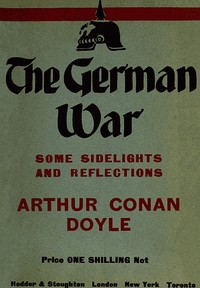
Before opening The German War — Context and Discussion, the edition data offers a quick orientation: 32,290 words, 2 hr 21 min estimated reading time, and 4 detected text sections.
The text analysis averages about 23.8 words per sentence, while the detected sections provide another way to judge how the source is divided.
Project Gutenberg metadata also associates the work with “World War, 1914-1918,” connecting these edition facts with the source record’s subject description.
Explore this collection
These alternatives are selected using recorded categories and estimated reading time.
About 134 minutes
World Events
30,681 recorded words. 7 minutes difference from this book's estimate.
View Gutenberg source #25573About 170 minutes
World Events
38,986 recorded words. 29 minutes difference from this book's estimate.
View Gutenberg source #20435About 103 minutes
World Events
23,512 recorded words. 38 minutes difference from this book's estimate.
View Gutenberg source #49208Search stored excerpts and compare books → Choose by your preferences →
Choices use stored catalog measurements. Estimates vary with reading speed. A shared category is a catalog label, not a claim that two books have the same argument or literary quality.
Search reads excerpt text stored with this catalog and links to its associated Gutenberg record. The connection is stored in the site database; this tool does not recheck that every excerpt is word-for-word identical to that external record. Excerpt search does not cover every chapter and does not verify historical publication dates.
Catalog snapshot checked: 2026-09-25. Coverage: 94 public books, 94 available source excerpts.
Calculated from edition completeness, EPUB availability, text structure and catalogue metadata. Not a user rating.
Total of 100 points, scaled to a 2.5-5.0 range. Editions with an empty description or a missing EPUB file are not scored.
Public-domain source text
The source text is kept in the dedicated reader, separate from this catalogue record and its commentary.
Arthur Conan Doyle, best known for his Sherlock Holmes stories, turns his attention to the outbreak of the First World War in this collection of essays written during 1914. The book opens with a preface dated November 1914, in which Doyle states that the essays were originally published in The Fortnightly Review and The Daily Chronicle, and that he has left them as written even where later events modified his views. The first essay, 'The Causes of the War,' was issued as a recruiting pamphlet in Britain and translated into Dutch and Danish, with 25,000 copies distributed in each country. Doyle frames the conflict as a fight for national life and insists that 'words can bring the men' if they clarify the justice of the cause.
Doyle’s prose is driven by a sense of immediate crisis. In the opening essay, he writes that 'it is not words and phrases that we need, but men, men—and always more men.' This refrain underscores the book’s dual purpose: to explain the war to neutrals and to galvanize British readers. The essays were themselves tools of war, reprinted as pamphlets and distributed abroad. Doyle explicitly states that if words can bring soldiers, 'then they are of avail.' The rhetorical strategy is one of moral clarity: he insists that knowledge of the justice of the cause gives 'more strength in our arms and more iron in our souls.' The tone is urgent, direct, and unapologetically partisan.
Doyle devotes an entire essay to what he calls 'A Policy of Murder,' accusing Germany of systematic violations of the laws of war. He cites the bombing of unfortified towns, the use of aircraft to drop bombs on civilians, and the treatment of Belgian civilians. He compares German conduct unfavorably to Wellington’s occupation of southern France in 1813, where 'no one was injured, nothing was taken without full payment.' Doyle argues that German actions—from Visé to Louvain to Aerschott—constitute a 'murderous innovation' that must be 'sternly repressed' to prevent a sinister precedent. He quotes a German officer’s diary entry: 'Our men behaved like regular Vandals.' The evidence, he claims, comes from German sources themselves.
The book is organized into nine essays, beginning with 'The Causes of the War' and ending with 'Afterthoughts.' The contents page shows a progression from explaining the war’s origins to analyzing German conspiracy, military doctrine, and specific atrocities. Doyle distinguishes between 'the general situation' and 'the special quarrel' that triggered the conflict. The essays vary in length; the longest appeared in The Fortnightly Review, while shorter ones were newspaper pieces. Doyle acknowledges that his views evolved, but he chose not to revise them. The collection thus preserves the raw, contemporary perspective of a prominent British writer in the first months of the war.
Readers should approach The German War as a primary source from the early war period, not as a historical analysis. Doyle’s essays are explicitly intended to influence opinion and recruit soldiers. The book reveals how an established author deployed his reputation for a national cause, blending moral argument with detailed accusations. The absence of later events—such as the full course of the war—makes this a snapshot of 1914 attitudes, useful for understanding wartime propaganda and the mindset of the British home front.
Reading Doyle’s wartime essays, I felt that same ache of watching good men march toward a fogged horizon, certain of justice yet blind to the cost. It made me think of another shore, where that certainty met the tide. I found myself turning to Gallipoli — A Closer Reading afterward, and somehow the silence between those two books felt like all of history’s weary breath.
Capture what you thought, learned, and would like to remember.