About 217 minutes
German Atrocities: An Official Investigation — A Closer Reading
World Events
49,896 recorded words. 6 minutes difference from this book's estimate.
View Gutenberg source #52679
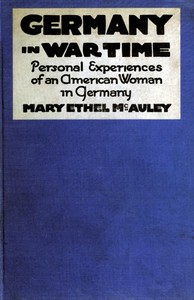
This digital edition of Germany in War Time: What an American Girl Saw and Heard — Inside the Classic is described by source-level measurements including 51,077 words, 3 hr 43 min estimated reading time, and 7 detected text sections.
The text analysis averages about 17.6 words per sentence, while the detected sections provide another way to judge how the source is divided.
Project Gutenberg metadata also associates the work with “World War, 1914-1918 -- Germany,” connecting these edition facts with the source record’s subject description.
Explore this collection
These alternatives are selected using recorded categories and estimated reading time.
About 217 minutes
World Events
49,896 recorded words. 6 minutes difference from this book's estimate.
View Gutenberg source #52679About 215 minutes
World Events
49,230 recorded words. 8 minutes difference from this book's estimate.
View Gutenberg source #53682About 239 minutes
World Events
54,880 recorded words. 16 minutes difference from this book's estimate.
View Gutenberg source #3092Search stored excerpts and compare books → Choose by your preferences →
Choices use stored catalog measurements. Estimates vary with reading speed. A shared category is a catalog label, not a claim that two books have the same argument or literary quality.
Search reads excerpt text stored with this catalog and links to its associated Gutenberg record. The connection is stored in the site database; this tool does not recheck that every excerpt is word-for-word identical to that external record. Excerpt search does not cover every chapter and does not verify historical publication dates.
Catalog snapshot checked: 2026-09-25. Coverage: 94 public books, 94 available source excerpts.
Calculated from edition completeness, EPUB availability, text structure and catalogue metadata. Not a user rating.
Total of 100 points, scaled to a 2.5-5.0 range. Editions with an empty description or a missing EPUB file are not scored.
Public-domain source text
The source text is kept in the dedicated reader, separate from this catalogue record and its commentary.
Mary Ethel McAuley opens her account with a practical detail: the only wartime route into Germany ran through Denmark, requiring a ferry to a small island and a thorough search at the Danish frontier. She notes that when she entered in October 1915, regulations were still lenient, but within two years they had tightened considerably. This focus on logistics sets the tone for a narrative grounded in concrete observation rather than broad political argument.
McAuley identifies herself as an American girl whose primary interest was art, and she states her intention to write without fear or favor. The table of contents reveals a wide range of topics—from soldiers and women workers to food, mail, and the treatment of Americans—suggesting a mosaic of everyday experiences rather than a continuous story.
The opening chapter describes the journey through Warnemünde, the only entry point for neutrals. McAuley emphasizes the changing rules: by the time she left, even neutral entry had become difficult. Later chapters detail moving within Berlin—finding apartments, using typewriters, and navigating a city under wartime restrictions. She observes that mail to soldiers on the western front traveled faster than to the eastern front, and that mail was routed through a central station in Hanover to keep troop locations secret. These logistical details reveal how war reshaped everyday movement and communication.
McAuley devotes multiple chapters to food and rationing, including one titled “What We Ate in Germany.” She describes the concept of Sparsamkeit (thrift) as a national virtue enforced by scarcity. The chapter “The Clothes Ticket” hints at a system of clothing rationing. Her observations are specific: she notes what was available, what was scarce, and how people adapted. These details ground the narrative in material reality, showing how war affected daily consumption and social habits.
One of the most vivid excerpts recounts a lecture by a German count on Ausländerei—the German fondness for foreign things. He criticized the use of English words like “hotel” and “messenger boys,” preferring German alternatives such as Blitzjunge. He lamented that German women followed Paris fashions and that men styled themselves “Oxford men.” McAuley notes that such views were not universal: she spoke English openly in Berlin and was only twice asked to stop. This episode captures the internal debate about national identity during war, without claiming to represent all Germans.
McAuley includes chapters on women workers and war charities, reflecting the mobilization of civilian labor. She describes women taking on roles traditionally held by men, and she notes the organized efforts to support soldiers and their families. The chapter “What Germany is Doing for Her Human War Wrecks” suggests attention to wounded soldiers and rehabilitation. These sections, based on what she saw and heard, provide a window into the home front without venturing into military strategy or politics.
McAuley’s account is best read as a series of snapshots rather than a continuous argument. Her perspective as an American art student—neither a journalist nor a diplomat—gives weight to her observations of daily life. Readers should note that the excerpts cover only a portion of the book; the full text includes chapters on Munich, Vienna, and the Krupp works. The value lies in the accumulation of small, specific details that together convey the texture of wartime Germany as experienced by a neutral outsider.
Reading her pages about the quiet dread of ration lines and whispered news, I kept thinking of the harder-edged voices in True Stories of the Great War, Volume 3 (of 6) Tales of Adventure--Heroic Deeds--Exploits Told by the Soldiers, Officers, Nurses, Diplomats, Eye Witnesses — Themes and Context. Her war was small and personal; theirs was loud and terrible. Somehow the contrast made me feel the whole weight of that time, even after I closed the book.
Build a private reading journal entry for this title.