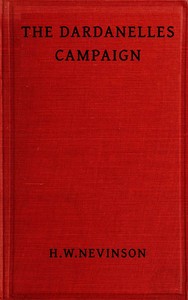
The Dardanelles campaign — Background and Themes

(0 User reviews)   832
In Category - World Events
Nevinson, Henry Woodd, 1856-1941 Project Gutenberg 2023 Not confirmed
World War, 1914-1918 -- Campaigns -- Turkey -- Gallipoli Peninsula Readers of public-domain and historical texts
Project Gutenberg digital edition en

Edition facts

Words 128,757
Reading time 560 min
Text sections 33

This digital edition of The Dardanelles campaign — Background and Themes is described by source-level measurements including 128,757 words, 9 hr 20 min estimated reading time, and 33 detected text sections.

The text analysis averages about 19.4 words per sentence, while the detected sections provide another way to judge how the source is divided.

Project Gutenberg metadata also associates the work with “World War, 1914-1918 -- Campaigns -- Turkey -- Gallipoli Peninsula,” connecting these edition facts with the source record’s subject description.

Explore this collection

Compare your next read

These alternatives are selected using recorded categories and estimated reading time.

Search stored excerpts and compare books → Choose by your preferences →

How these choices and excerpts are prepared

Choices use stored catalog measurements. Estimates vary with reading speed. A shared category is a catalog label, not a claim that two books have the same argument or literary quality.

Search reads excerpt text stored with this catalog and links to its associated Gutenberg record. The connection is stored in the site database; this tool does not recheck that every excerpt is word-for-word identical to that external record. Excerpt search does not cover every chapter and does not verify historical publication dates.

Catalog snapshot checked: 2026-09-25. Coverage: 94 public books, 94 available source excerpts.

Nevinson's 1920 account of the Gallipoli campaign combines classical allusion with precise tactical detail, as seen in his description of the Light Horse charge at the Nek. The preface reveals a personal attraction to the Dardanelles as the setting of Trojan epics, while the narrative focuses on specific terrain and troop movements.
Share
Editorial Edition Score 4.9/5

Calculated from edition completeness, EPUB availability, text structure and catalogue metadata. Not a user rating.

How this score is calculated
  • Description quality20 pts
  • Title & short description10 pts
  • Source metadata20 pts
  • Text length15 pts
  • Chapters / structure15 pts
  • EPUB file integrity20 pts

Total of 100 points, scaled to a 2.5-5.0 range. Editions with an empty description or a missing EPUB file are not scored.

Edition quality

Public-domain source text

Read the source text

The source text is kept in the dedicated reader, separate from this catalogue record and its commentary.

Nevinson opens his preface by stating that the Dardanelles Campaign attracted him with peculiar interest because the shores of the Straits were the scene of the Trojan epics and dramas, a landscape familiar from boyhood. This classical framing sets the tone for a narrative that blends personal engagement with military history. The excerpts show a writer who moves between strategic overview and minute tactical detail, as in the account of the Nek—a flat isthmus 80 yards long connecting Sari Bair to Russell's Top. Nevinson describes the Turkish redoubt called 'The Chessboard' and the charge of the 8th and 10th Light Horse Regiments, noting that each man carried 200 rounds but was ordered to trust to the fixed bayonet alone.

Classical Allusions and Strategic Vision

The preface dedicates the book to those who fell on the Gallipoli Peninsula, quoting Aeschylus and Thucydides in Greek. Nevinson writes that the campaign attracted him because the shores were the scene of the Trojan epics and dramas, and because he regarded it as a strategic conception surpassing others in promise. This dual lens—mythological and strategic—shapes the narrative. The excerpts do not reveal whether Nevinson sustains this classical framework throughout the book, but the opening establishes a distinctive voice that treats the campaign as both a modern military operation and a continuation of ancient conflicts on the same ground.

Terrain and Tactical Geography

Nevinson's descriptions of terrain are precise and functional. The Nek is an isthmus of high cliff, flat and open at the top, about 80 yards long and little over 100 yards in breadth. He notes that on the right it falls steeply into Monash Gully, and on the left into deep ravines running to Ocean Beach. The Turkish redoubt, 'The Chessboard,' is named for its complicated chequer of trenches. Behind it, the ground slopes up to Baby 700, then to Chunuk Bair. This geographical detail is not ornamental; it explains why the charge across the Nek was so deadly—the Turks were raised tier above tier, with machine-guns pumping bullets in convergent streams.

The Charge at the Nek: Structure and Detail

The assault was entrusted to the 8th (Victorian) and 10th (West Australian) Regiments of the 3rd Light Horse Brigade. Two parties of 150 men were selected from each regiment—600 in all. They filed into trenches just before dawn on Saturday, 7th, in shirts and shorts, with sleeves rolled up, carrying water-bottles and packs containing food, photographs, letters, and souvenirs. The first line took two scaling-ladders; the fourth had picks and shovels. At 4 a.m., a 25-minute bombardment began. Lieutenant-Colonel White said 'Good-bye, Antill!' and watched the minute hand. At 'Go!' the first 150 leapt into a blinding storm of bullets. Not one got more than half-way across. The second line followed to the same destruction. A small red and yellow flag was seen for about two minutes waving over the enemy's parapet—the agreed signal—but it disappeared.

Nevinson's account is valuable for its combination of personal motivation and granular reporting. Readers should note that the excerpts cover only a small portion of a 128,757-word text. The preface suggests a broader strategic argument, while the Nek passage shows a willingness to dwell on the fate of individual units. Those interested in the relationship between classical education and military history will find the opening particularly suggestive, though the bulk of the work likely focuses on operations rather than literary reflection.

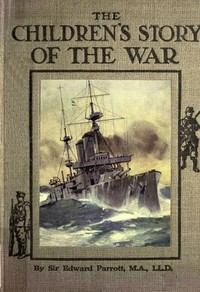
Reading Nevinson’s account of the Nek, I remembered my grandfather’s maps, annotated with Greek place-names — he saw Troy there, too. His old copy of The Childrens' Story of the War, Volume 3 (of 10) From the First Battle of Ypres to the End of the Year 1914 — Key Ideas to Explore gave me the same ache: boys marching into mud, and the weight of all that history pressing on their shoulders.

There are no reviews for this eBook.

0
0 out of 5 (0 User reviews )

Add a Review

Your Rating *
There are no comments for this eBook.

Reader reflection

What did you think of this book?

Answer a few questions and save a private reflection on this device.

Your progress 0 / 10
1

What is your current status with this title?

2

Was reading this book enjoyable?

3

Would you pass this book on to a friend?

4

How much effort did this book require?

Related eBooks