About 291 minutes
German Barbarism: A Neutral's Indictment — Context and Discussion
World Events
66,892 recorded words. 20 minutes difference from this book's estimate.
View Gutenberg source #57424
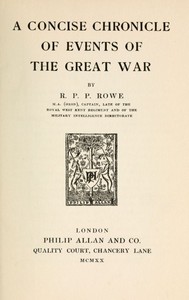
A Concise Chronicle of Events of the Great War — Text and Context can be approached with a clearer sense of reading commitment from its source measurements: 71,473 words, 5 hr 11 min estimated reading time, and 13 detected text sections.
The text analysis averages about 15.8 words per sentence, while the detected sections provide another way to judge how the source is divided.
Project Gutenberg metadata also associates the work with “World War, 1914-1918 -- Chronology,” connecting these edition facts with the source record’s subject description.
Explore this collection
These alternatives are selected using recorded categories and estimated reading time.
About 291 minutes
World Events
66,892 recorded words. 20 minutes difference from this book's estimate.
View Gutenberg source #57424About 346 minutes
World Events
79,437 recorded words. 35 minutes difference from this book's estimate.
View Gutenberg source #55503About 252 minutes
World Events
57,845 recorded words. 59 minutes difference from this book's estimate.
View Gutenberg source #67103Search stored excerpts and compare books → Choose by your preferences →
Choices use stored catalog measurements. Estimates vary with reading speed. A shared category is a catalog label, not a claim that two books have the same argument or literary quality.
Search reads excerpt text stored with this catalog and links to its associated Gutenberg record. The connection is stored in the site database; this tool does not recheck that every excerpt is word-for-word identical to that external record. Excerpt search does not cover every chapter and does not verify historical publication dates.
Catalog snapshot checked: 2026-09-25. Coverage: 94 public books, 94 available source excerpts.
Calculated from edition completeness, EPUB availability, text structure and catalogue metadata. Not a user rating.
Total of 100 points, scaled to a 2.5-5.0 range. Editions with an empty description or a missing EPUB file are not scored.
Public-domain source text
The source text is kept in the dedicated reader, separate from this catalogue record and its commentary.
R. P. P. Rowe's A Concise Chronicle of Events of the Great War presents a day-by-day account of World War I, structured by year and month. The author, a former captain and intelligence officer, explicitly omits maps, arguing that most significant locations are small villages requiring large-scale maps. Instead, he takes "pains to indicate accurately the position of every place whose locality might be unfamiliar," embedding geographical precision into the text itself.
The narrative voice is consistently factual and detached, relying on official sources for battle names, dates, and strategic aims. This approach creates a uniform tone across the chronicle, but the pace of events shifts markedly: early entries are sparse and measured, while the 1918 entries accelerate into dense, rapid-fire reports of territorial gains, prisoner counts, and armistice negotiations.
Rowe's decision to exclude maps shapes the entire work. In the introduction, he notes that "the number of towns, as opposed to villages, which were definitely connected with the war is surprisingly small," and that most places are "marked only in maps of an exceptionally large scale." To compensate, he provides detailed locational cues within entries. For example, on September 25, 1918, he records that "the British enter Bulgaria near Kosturino," and on September 26, the Americans and French attack "from the Meuse to the Suippe." These phrases anchor each event without requiring a visual aid. The result is a text that functions as its own atlas, where every place name carries a contextual coordinate. This method also reflects Rowe's background in military intelligence, where precise location reporting was essential. Readers must engage actively with the text, piecing together geography from repeated references to rivers, ridges, and railways.
Rowe consistently adopts official or authoritative sources for battle names and dates, as he states in the introduction. Entries such as "The Fourth Battle of Ypres" (September 28, 1918) and "The Battle of Cambrai and the Hindenburg Line" (September 27) are introduced with formal titles, often followed by brief strategic notes. For instance, the Fourth Battle of Ypres is described as ending when "an important salient being thus driven into the enemy's northern front which endangers his positions on the Belgian coast." These summaries are rare but pointed, appearing mainly in 1918. Earlier years lack such commentary, suggesting a shift in narrative approach as the war progressed. The strategic notes are terse—never more than a sentence—and avoid speculation. They serve to connect discrete events to larger operational goals, but Rowe never claims insight beyond what official sources provided. This restraint keeps the chronicle anchored in verifiable fact.
The chronicle's rhythm changes dramatically in 1918. Early entries are brief and evenly spaced, but from September 1918 onward, the text becomes a torrent of daily gains. On September 25 alone, three fronts see action: the Macedonian Front, Palestine, and the Argonne. Prisoner counts escalate: "captures to date approximate 45,000 prisoners and 265 guns" (September 25), and by September 27, "over 10,000 prisoners and 200 guns" are taken at Cambrai. The language shifts from static reports to verbs of movement: "capture," "occupy," "break through," "advance." The entry for September 29 records the end of the Fourth Battle of Ypres and simultaneous progress on the Cambrai–St. Quentin front. This density mirrors the actual collapse of German defenses. Rowe's chronicle, by adhering to a strict chronological framework, forces the reader to experience the war's accelerating tempo firsthand, without narrative embellishment.
Rowe's chronicle rewards readers who attend to its geographical and chronological structure. The absence of maps is not a flaw but a deliberate choice that foregrounds language as a tool for orientation. Pay attention to the shifting density of entries—the sparse early years give way to a cascade of events in 1918, reflecting the war's final convulsions. The official battle names and strategic notes, though rare, offer clues to how contemporaries understood the conflict's turning points.
My old copy of A Concise Chronicle has softened at the spine from years of handling, its daily entries a solemn rhythm. Those final advances of 1918 rattle the frame, yet what lingers is the quiet elsewhere—the grit and needle of ordinary hands. Beside it sits Doing Their Bit: War Work at Home — Text and Context, the same relentless time measured in mended socks and penciled ledgers. Both speak of endurance, just different trenches.
Save your reaction, strongest insight, and memorable passage.