About 102 minutes
The Myth of a Guilty Nation — Inside the Classic
World Events
23,410 recorded words. 1 minutes difference from this book's estimate.
View Gutenberg source #44508
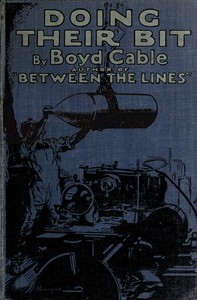
Before opening Doing Their Bit: War Work at Home — Text and Context, the edition data offers a quick orientation: 23,512 words, 1 hr 43 min estimated reading time, and 12 detected text sections.
The text analysis averages about 32.9 words per sentence, while the detected sections provide another way to judge how the source is divided.
Project Gutenberg metadata also associates the work with “World War, 1914-1918,” connecting these edition facts with the source record’s subject description.
Explore this collection
These alternatives are selected using recorded categories and estimated reading time.
About 102 minutes
World Events
23,410 recorded words. 1 minutes difference from this book's estimate.
View Gutenberg source #44508About 100 minutes
World Events
22,843 recorded words. 3 minutes difference from this book's estimate.
View Gutenberg source #51024About 77 minutes
World Events
17,505 recorded words. 26 minutes difference from this book's estimate.
View Gutenberg source #23163Search stored excerpts and compare books → Choose by your preferences →
Choices use stored catalog measurements. Estimates vary with reading speed. A shared category is a catalog label, not a claim that two books have the same argument or literary quality.
Search reads excerpt text stored with this catalog and links to its associated Gutenberg record. The connection is stored in the site database; this tool does not recheck that every excerpt is word-for-word identical to that external record. Excerpt search does not cover every chapter and does not verify historical publication dates.
Catalog snapshot checked: 2026-09-25. Coverage: 94 public books, 94 available source excerpts.
Calculated from edition completeness, EPUB availability, text structure and catalogue metadata. Not a user rating.
Total of 100 points, scaled to a 2.5-5.0 range. Editions with an empty description or a missing EPUB file are not scored.
Public-domain source text
The source text is kept in the dedicated reader, separate from this catalogue record and its commentary.
Boyd Cable opens Doing Their Bit by contrasting his initial impression of a peaceful home front with the reality he later witnessed: a nation ‘sweating at forge and furnace’ behind guarded doors. Written in 1915–16 and published with a preface by David Lloyd George, the book aims to show soldiers how civilians are supplying them. Cable’s prose is direct, often using mechanical metaphors—‘juggling with lathes and stamps and presses’—to convey the scale and urgency of munitions work.
Cable frames his authority by stating he ‘came here from the Front a couple of months ago.’ This vantage point shapes his descriptions: he notes the khaki that ‘swarms and hives’ in outer areas but only ‘trickles through the big towns.’ His eye for detail is evident in the way he watches a fuse-testing girl: he describes her ‘flick one quick upward glance’ before returning to work, and he tries to catch the clock-finger at the instant a black hole appears. The manager’s explanations are woven into the narrative, but Cable also records his own struggle to see what the operator sees—‘simply because that girl was so impishly quick.’ This layered observation gives the reader a sense of both the technical process and the human speed required.
Cable lingers on the mechanical details of fuse testing. The machine spins a fuse until it becomes ‘a mere blur’; a shutter must open only at a specific speed to avoid premature bursts. The manager explains that the test checks ‘against premature bursts, I believe’—the slight uncertainty in his phrasing suggests the limits of what even insiders knew. Cable notes the girl’s ‘flying fingers never halted or slowed,’ and when she spots a fault, she ‘prodded and fiddled at it a moment with some mysteriously appearing tools’ before rectifying it herself. The passage conveys the split-second judgments and manual dexterity required, without romanticizing the work.
Throughout the excerpts, women are shown as ‘fresh young girls and elderly toil-worn women alike, closely intent on their work.’ Cable emphasizes that they waste ‘no fraction of a second’ between tool changes, because delay means ‘waste of a valuable lathe’s time as well as the operator’s.’ The fuse-testing girl answers the manager without lifting her head, and when Cable speaks to her about the danger of faulty fuses, she gives ‘that quick glance’ again but keeps working. The narrative resists sentimentality; instead, it records the women’s ‘deftness and hustling intentness’ as a matter of fact. Cable’s own role as an observer is acknowledged—he is allowed to see what ‘not given to many to see’—but the focus remains on the workers’ unbroken concentration.
Cable’s diction is concrete and kinetic: ‘sweating at forge and furnace,’ ‘juggling with lathes,’ ‘driving the work.’ He uses mechanical terms—‘breech-block,’ ‘revolving-wheel centre,’ ‘clock-face’—without glossing them, trusting the reader to follow. The preface by Lloyd George frames the book as a morale tool for troops, but Cable’s own voice is more that of a witness than a propagandist. He records the manager’s casual ‘I believe’ about the fuse’s purpose, and he notes that the girl ‘appeared to be doing two things at once all the time.’ The prose is lean, avoiding the florid language common in contemporary war writing, and instead relies on the accumulated weight of precise observation.
Cable’s account is valuable not for grand claims but for its close attention to the physical and mental demands of factory work in 1915–16. Readers interested in the texture of industrial labor during World War I will find a reporter’s eye for detail, tempered by the awareness that he is describing a world most soldiers never saw. The book’s brevity and focus make it a companion to frontline memoirs rather than a comprehensive history.
The rain drummed on the windowsill while I read Boyd Cable’s account of young women in the shell factories—their careful, rhythmic work under terrible pressure. That quiet intensity stayed with me afterwards, the sense of a whole people straining under a weight they couldn’t name. It made me pick up something else, a counterweight: German Atrocities from German Evidence — Inside the Classic. One records the making, the other the breaking.
Build a private reading journal entry for this title.