About 77 minutes
The Eyes of Asia — Key Ideas to Explore
World Events
17,505 recorded words. 26 minutes difference from this book's estimate.
View Gutenberg source #23163
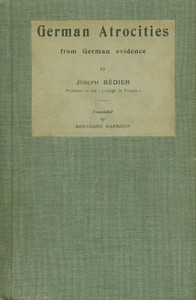
The source record for German Atrocities from German Evidence — Inside the Classic measures this digital text at 11,598 words, 51 min estimated reading time, and 2 detected text sections.
The text analysis averages about 17.7 words per sentence, while the detected sections provide another way to judge how the source is divided.
Project Gutenberg metadata also associates the work with “World War, 1914-1918 -- Atrocities,” connecting these edition facts with the source record’s subject description.
Explore this collection
These alternatives are selected using recorded categories and estimated reading time.
About 77 minutes
World Events
17,505 recorded words. 26 minutes difference from this book's estimate.
View Gutenberg source #23163About 23 minutes
World Events
5,270 recorded words. 28 minutes difference from this book's estimate.
View Gutenberg source #47149About 100 minutes
World Events
22,843 recorded words. 49 minutes difference from this book's estimate.
View Gutenberg source #51024Search stored excerpts and compare books → Choose by your preferences →
Choices use stored catalog measurements. Estimates vary with reading speed. A shared category is a catalog label, not a claim that two books have the same argument or literary quality.
Search reads excerpt text stored with this catalog and links to its associated Gutenberg record. The connection is stored in the site database; this tool does not recheck that every excerpt is word-for-word identical to that external record. Excerpt search does not cover every chapter and does not verify historical publication dates.
Catalog snapshot checked: 2026-09-25. Coverage: 94 public books, 94 available source excerpts.
Calculated from edition completeness, EPUB availability, text structure and catalogue metadata. Not a user rating.
Total of 100 points, scaled to a 2.5-5.0 range. Editions with an empty description or a missing EPUB file are not scored.
Public-domain source text
The source text is kept in the dedicated reader, separate from this catalogue record and its commentary.
Joseph Bédier opens his 1915 pamphlet with a methodological declaration: he will prove German violations of the law of nations using only German sources. A professor at the Collège de France and a trained paleographer, Bédier applies the same critical scrutiny he would to an ancient chronicle, examining confiscated war diaries and official reports. The result is a work that functions simultaneously as a wartime polemic and a documentary exercise in source criticism.
Bédier explicitly refuses to cite French or Belgian testimony, which he calls “true though I know it to be.” Instead, he draws evidence from German war diaries—specifically those kept under Article 75 of the German Army's field service regulations—captured from prisoners. His rationale is tactical: no German, he claims, can refute his own country's documents. The approach gives the pamphlet a distinctive rhetorical structure: accusation is channeled through the enemy's own words, turning captured diaries into courtroom exhibits.
The translator, Bernhard Harrison, preserves Bédier's scholarly tone. The text includes references to plates (reproductions of diary pages) and to the work of the Marquis de Dampierre, an archivist preparing a fuller collection. Bédier's method is forensic: he treats each diary entry as a piece of material evidence, subject to the same authentication he would use for a medieval charter.
One of the most striking excerpts comes from the diary of Private Paul Glöde of the 9th Battalion of Pioneers. Dated 12 August 1914, it describes the destruction of Belgian villages and the execution of civilians. Glöde writes of “heaps of dead men and women who had been executed after trial” and notes that “mutilation of the wounded is the order of the day.” Bédier juxtaposes this with the claim that the diary was written only eight days after the invasion of Belgium.
The diary entry is notable for its tone: Glöde expresses sadness for the inhabitants, yet records atrocities as routine. Bédier uses this to argue that such acts were not spontaneous but systematic. The passage also reveals a tension between the soldier's personal voice and the official culture that permitted—or encouraged—such violence.
Bédier describes a newspaper article written by a German soldier of the 154th Regiment, celebrating his unit as worthy of the name “Königsbrigade.” The article ends with a prayer of thanksgiving and was submitted to a lieutenant who certified it with his seal. Bédier then asks his reader whether such an article could appear in any country other than Germany, implying that the public celebration of violence was uniquely German.
This section shifts the focus from battlefield acts to the home front. The article was published in the town of Jauer, where editors, compositors, and readers participated in its dissemination. Bédier's argument here is that the atrocities were not merely tolerated but celebrated, forming part of a broader cultural complicity. The rhetorical question—“can he imagine such an article being printed in his own language?”—is designed to provoke the reader into recognizing a difference in national character.
Bédier's pamphlet is best read as a document of its moment: a wartime argument built on a narrow but carefully chosen evidentiary base. Readers should note that the excerpts are incomplete—the full text includes additional diary entries and official documents. The work's value lies less in its conclusions than in its method: the attempt to let the enemy's own words serve as proof. For those interested in the history of propaganda or the use of documentary evidence in polemics, this is a revealing case study.
That rainy afternoon, Bédier’s relentless documentary proof left me cold—not the facts, but the sheer weight of recorded cruelty. I closed it, staring out at the grey sky, and my hand drifted to a slimmer volume on my shelf about another doomed campaign. The quiet folly of Gallipoli felt like a release. Gallipoli — A Closer Reading offered no such moral certainties.
Your answers remain private and are stored only in this browser.