About 217 minutes
German Atrocities: An Official Investigation — A Closer Reading
World Events
49,896 recorded words. 2 minutes difference from this book's estimate.
View Gutenberg source #52679
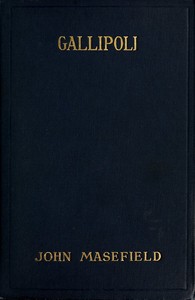
The source record for Gallipoli — A Closer Reading measures this digital text at 49,230 words, 3 hr 35 min estimated reading time, and 7 detected text sections.
The text analysis averages about 26.1 words per sentence, while the detected sections provide another way to judge how the source is divided.
Project Gutenberg metadata also associates the work with “World War, 1914-1918 -- Campaigns -- Turkey -- Gallipoli Peninsula,” connecting these edition facts with the source record’s subject description.
Explore this collection
These alternatives are selected using recorded categories and estimated reading time.
About 217 minutes
World Events
49,896 recorded words. 2 minutes difference from this book's estimate.
View Gutenberg source #52679About 223 minutes
World Events
51,077 recorded words. 8 minutes difference from this book's estimate.
View Gutenberg source #46186About 200 minutes
World Events
45,844 recorded words. 15 minutes difference from this book's estimate.
View Gutenberg source #40507Search stored excerpts and compare books → Choose by your preferences →
Choices use stored catalog measurements. Estimates vary with reading speed. A shared category is a catalog label, not a claim that two books have the same argument or literary quality.
Search reads excerpt text stored with this catalog and links to its associated Gutenberg record. The connection is stored in the site database; this tool does not recheck that every excerpt is word-for-word identical to that external record. Excerpt search does not cover every chapter and does not verify historical publication dates.
Catalog snapshot checked: 2026-09-25. Coverage: 94 public books, 94 available source excerpts.
Calculated from edition completeness, EPUB availability, text structure and catalogue metadata. Not a user rating.
Total of 100 points, scaled to a 2.5-5.0 range. Editions with an empty description or a missing EPUB file are not scored.
Public-domain source text
The source text is kept in the dedicated reader, separate from this catalogue record and its commentary.
John Masefield, better known as a poet and novelist, wrote this account of the Gallipoli Campaign in 1916, while the First World War was still being fought. The book is not a strategic analysis or a comprehensive history; it is a descriptive narrative that dwells on the terrain, the weather, and the physical conditions endured by the soldiers. Masefield’s prose is precise and sensory, often treating the landscape as a character in the drama. He describes the hills of Suvla as “tumbling precipitous disordered bulges of hill, cut by every kind of cleft and crumpled into every kind of fold,” and notes that the gulleys were “bone dry in August when the battle was fought.” These observations ground the campaign in a specific, unforgiving geography.
Masefield’s background as a poet is evident in his attention to the physical world. He does not simply name locations; he renders them as tactile, visual experiences. The hills around Suvla Bay are described as “high and proud to the north,” while the Anzac position is a “disarrangement of precipitous bulged hill” that “rises and falls in crags, peaks and gulleys.” He notes that the terrain is “trackless, waterless and confused, densely covered with scrub (sometimes with forest) littered with rocks, an untamed savage country.” This language conveys the difficulty of the campaign without resorting to abstract terms like “challenging” or “rugged.” Masefield’s descriptions are specific enough that a reader could almost sketch the landscape from his words.
Masefield writes as a contemporary, not a historian. He refers to the campaign as “a great human effort, which came, more than once, very near to triumph.” His tone is measured, but he does not pretend to omniscience. He mentions that he was “often questioned about the Dardanelles Campaign” during a visit to America, and that he felt “the need of a leaflet printed for distribution, giving my views of the matter.” This framing establishes the book as a personal response, not an official record. The prose is direct, avoiding the grandiloquence of later war writing. Masefield’s sentences are often short and declarative: “These hills are the scene of the bitterest fighting of the battle.”
The book is organized around geography rather than chronology. Masefield devotes long passages to describing the layout of Suvla Bay, the Salt Marsh, and the valleys of Anafarta. He explains the topography in terms of its military significance: the “big blunt-headed jut or promontory of higher ground” that thrusts toward the bay, and the “two gaps where the ancient harbour of our fancy thrust creeks far inland.” This structural choice emphasizes the physical constraints that shaped the fighting. Masefield also includes precise measurements—Chocolate Hill is “roughly 150 feet high,” and the peaks range “from about 250 to 600 feet”—which ground the narrative in verifiable fact.
Masefield’s diction is restrained but evocative. He describes the terrain as “savage” and “untamed,” but he rarely dwells on the suffering of individual soldiers. Instead, he implies the human cost through the landscape itself. The hills “stand (to the fancy) like a rank that has beaten back an attack.” The word “fancy” suggests a subjective, almost poetic interpretation, yet it is anchored in the reality of combat. Masefield also notes that the gulleys were “bone dry in August when the battle was fought,” a detail that hints at thirst and exhaustion without explicit statement. His language is careful, avoiding sensationalism while still conveying the harshness of the campaign.
Masefield’s Gallipoli is best approached as a descriptive essay rather than a military history. Readers interested in the strategic decisions or the political context will need to look elsewhere. But for those who want to understand what the ground itself demanded of the soldiers—the steep slopes, the dry watercourses, the scrub-choked ravines—this book offers a vivid, contemporary account. Masefield’s poet’s eye and his restrained prose make the landscape the central character, and the campaign’s tragedy emerges from the details of the terrain.
Reading Masefield’s account, you feel the weight of what was lost before anyone knew it was lost — the landscape already scarred, the names not yet ghostly. It reminds me of picking up Cetywayo and his White Neighbours Remarks on Recent Events in Zululand, Natal, and the Transvaal — Reading Companion years ago, that same ache of watching empires fumble into their own sorrows, told by someone who was there, not knowing the ending we now carry.
Save your reaction, strongest insight, and memorable passage.