About 215 minutes
Gallipoli — A Closer Reading
World Events
49,230 recorded words. 2 minutes difference from this book's estimate.
View Gutenberg source #53682
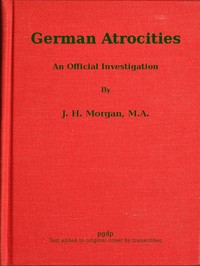
Before opening German Atrocities: An Official Investigation — A Closer Reading, the edition data offers a quick orientation: 49,896 words, 3 hr 37 min estimated reading time, and 5 detected text sections.
The text analysis averages about 23.2 words per sentence, while the detected sections provide another way to judge how the source is divided.
Project Gutenberg metadata also associates the work with “World War, 1914-1918 -- Atrocities,” connecting these edition facts with the source record’s subject description.
Explore this collection
These alternatives are selected using recorded categories and estimated reading time.
About 215 minutes
World Events
49,230 recorded words. 2 minutes difference from this book's estimate.
View Gutenberg source #53682About 223 minutes
World Events
51,077 recorded words. 6 minutes difference from this book's estimate.
View Gutenberg source #46186About 200 minutes
World Events
45,844 recorded words. 17 minutes difference from this book's estimate.
View Gutenberg source #40507Search stored excerpts and compare books → Choose by your preferences →
Choices use stored catalog measurements. Estimates vary with reading speed. A shared category is a catalog label, not a claim that two books have the same argument or literary quality.
Search reads excerpt text stored with this catalog and links to its associated Gutenberg record. The connection is stored in the site database; this tool does not recheck that every excerpt is word-for-word identical to that external record. Excerpt search does not cover every chapter and does not verify historical publication dates.
Catalog snapshot checked: 2026-09-25. Coverage: 94 public books, 94 available source excerpts.
Calculated from edition completeness, EPUB availability, text structure and catalogue metadata. Not a user rating.
Total of 100 points, scaled to a 2.5-5.0 range. Editions with an empty description or a missing EPUB file are not scored.
Public-domain source text
The source text is kept in the dedicated reader, separate from this catalogue record and its commentary.
J. H. Morgan, a barrister and constitutional law professor, structures this 1916 report as an official investigation into German violations of the laws of war. The book opens with a prefatory note acknowledging assistance from the Russian Embassy, Foreign Office, and British Expeditionary Force, establishing its documentary authority. Morgan immediately distinguishes his work from propaganda by including a critical analysis of the German White Book, framing the investigation as a legal rather than purely patriotic exercise.
Morgan's narrative voice is that of a legal professional, not a journalist. He frequently inserts editorial comments in brackets, such as "[This soldier was at times in great pain when he spoke, but his mind was clear. I am convinced he spoke the truth.—J. H. M.]" These interjections serve as credibility assessments, signaling to the reader which testimony Morgan deems reliable. His method is systematic: depositions are numbered, witnesses identified by rank and unit, and locations specified (e.g., Ypres, La Bassée, Estaires). The tone is clinical, but the accumulation of detail—a woman's breast cut "as if with a sword, not a bayonet"—creates a grim rhythm. Morgan's legal training is evident in his cross-referencing of testimonies and his insistence on corroboration, though he occasionally admits when evidence is hearsay, as with the Belgian farmer's account.
The book's pace shifts markedly between its two halves. The introductory chapter moves slowly, with Morgan dissecting the German White Book's claims in dense legal prose. He questions German credibility by pointing to internal inconsistencies and the absence of independent verification. The pace accelerates in the documentary chapter, where fifty-six depositions are presented in rapid succession, often in a single paragraph. Witnesses speak in short, declarative sentences: "The Germans advanced, and when they got up to the trenches, they shot them each in their trenches as they stood." This abrupt transition from analysis to raw testimony mirrors the shift from courtroom deliberation to battlefield immediacy. The final sections on incendiary bullets and Russian prisoners maintain this documentary tempo, with Morgan adding only minimal commentary.
Certain details recur across depositions, creating patterns that Morgan does not explicitly highlight but which accumulate through repetition. Witnesses frequently mention German officers threatening civilians with revolvers, the use of white flags to feign surrender, and the targeting of wounded soldiers. The phrase "outraged" appears repeatedly in accounts of sexual violence, often paired with the detail that the victim's family was present. Another recurring element is the presence of an English-speaking intermediary—a café proprietor, a priest, a farmer—who translates or vouches for the story. These intermediaries lend an air of reliability to accounts that might otherwise seem improbable. Morgan's decision to include multiple versions of similar incidents (e.g., the murder of civilians at Doulieu and Tamines) reinforces the sense of systematic abuse, though he never explicitly claims that these patterns prove a coordinated policy.
Readers should approach this text as a legal document first and a historical record second. Morgan's editorial interjections and the structure of the depositions reveal his effort to construct a case that would withstand scrutiny. The book's value lies not only in the atrocities it documents but in the methods Morgan uses to establish credibility—methods that remain relevant for evaluating wartime testimony today.
In that stern 1916 report, I kept noticing the witnesses’ weary voices. Years later, I found their echo in True Stories of the Great War, Volume 1 (of 6) Tales of Adventure--Heroic Deeds--Exploits Told by the Soldiers, Officers, Nurses, Diplomats, Eye Witnesses — A Closer Reading. One speaks of legal proof, the other of lived memory, yet both share that same hush between sentences—ordinary people trying to make the unbelievable bearable.
Answer a few questions and save a private reflection on this device.